🇧🇪
Belgium
Project Information
The Belgian approach to Learning in the Wild focuses on extending second language learning beyond formal classroom instruction and into everyday social environments. The project creates opportunities for learners of Dutch to engage with the language through authentic interaction, participation, observation, and reflection in real-life contexts.
Taalarena (“Language Arena”) is the Belgian contribution to the Erasmus+ project Second Language Learning in the Wild. Developed by the Support Center for Education in collaboration with language schools, municipalities, and the Center for Language and Education at KU Leuven, the project explores how adult learners of Dutch can build confidence and participation through real interactions outside the classroom.
Inspired by the Scandinavian initiatives The Icelandic Village and Språkskap, Taalarena combines classroom preparation, exploration in the city, and reflection afterwards. Learners engage with Dutch in everyday places such as libraries, shops, schools, parenting centers, and public services.
Magda Vanmontfort
Project Manager, Taalarena
Taalarena, Second Language Learning in the Wild
Read More
→
What
The Belgian journey into Second Language Learning in the Wild began through research rather than policy. While looking for ways to integrate second language learning into a motivation program for secondary schools, the Support Center for Education encountered the publication Usage-Based Perspectives on Second Language Learning (Cadierno & Eskildsen, 2015). Within it, Johannes Wagner’s contribution on Language Learning in the Wild introduced the idea of connecting classroom language teaching with “second language encounters outside of the classroom” and exploring “how language teaching can dock onto experiences with the second language outside of the classroom, support and even enhance them.”

second language encounters outside of the classroom” and exploring “how language teaching can dock onto experiences with the second language outside of the classroom, support and even enhance them.
This immediately resonated with an already existing usage-based approach within the Support Center’s work together with the Center for Language and Education at KU Leuven. The idea that learners of Dutch as a second language could actively interact in Dutch outside school suddenly felt obvious, even though, as they write, “the idea to do so had never occurred to us before.”
The project became deeply influenced by the Scandinavian examples of The Icelandic Village and Språkskap. The Icelandic Village was described as creating “a protected language arena for newly arrived students who start their journey in the Icelandic life-world,” where newcomers could observe how locals organize activities. Språkskap introduced the idea of “mapping” language arenas and allowing newcomers to “colonize” their environments and expand their “circles.” Inspired by this, the Belgian team named their project Taalarena (“Language Arena”), adopting the idea of the outside world as an experiential arena for language learning.
At the same time, local municipalities in Belgium observed that many foreign-speaking families tended to “fold back on themselves,” limiting opportunities to meet Dutch-speaking people and participate in local life. Taalarena therefore became both a language initiative and a social participation project, focused on supporting adult language learners in moving through everyday Dutch-speaking environments with greater confidence and agency.
Challenges and Opportunities


Genk
Challenges in language learning in Belgium
One of the main challenges was shifting from traditional “teaching language” toward supporting learners in real-life participation. Teachers initially worried that students needed strict structure, teacher control, and grammar-focused exercises in order to feel safe. Another challenge was sustainability. Some schools struggled to structurally integrate Taalarena because of staff turnover, school policies, lack of time, or insufficient student enrollment. Teachers also described tensions between experimental learning approaches and increasingly strict language testing requirements in Flanders.
How
The project used collaborative design to explore possibilities through action.
Participants were encouraged to try things out, reflect on what happened, and adapt their approaches over time. The process relied on experimentation rather than implementation.
Simple materials such as photographs, maps, notebooks, sketches, and mock-ups were used to make experiences visible and discussable. Activities often moved between spaces for reflection and spaces for action, allowing participants to rehearse, participate, document, and reflect.
Three recurring approaches appeared throughout the project:

Linking rehearsal spaces and real-life situations: Creating opportunities to move between preparation and participation.
Mapping people, places, and time: Making everyday language opportunities visible.

Connecting interaction with simple technologies: Using existing technologies to document, share, and reflect on experiences.
Instances
We never considered those situations meaningful before
During a scouting activity, teachers explored the school building and surrounding neighborhood in small groups. Many were surprised by how many resources for interaction already existed around them. One teacher, who previously only sent students to shops or train stations, realized that there was “a lot more information that you can tap into” in ordinary environments. Teachers described the activity as an “eye opener,” changing how they perceived everyday spaces.
The German Library
One workshop transformed the meeting room into a German library. Teachers who did not feel comfortable speaking German became the language learners themselves. They prepared questions about books, entered the interaction with the “librarian,” became confused when the conversation shifted unexpectedly, and later reflected together on how easily control disappeared during real interaction.
During reflection, teachers began proposing strategies they had never previously emphasized with students: cue cards, repetition, asking people to repeat themselves, using safe spaces inside shops, practicing support phrases repeatedly beforehand. One teacher reflected:
Something in your hands can help you feel more comfortable. It might not be perfect, but it could help you not to be afraid to speak.
The Pineapple
During a later workshop, one teacher casually mentioned buying a pineapple. The conversation expanded into a reflection on how even a simple object could generate multiple language situations: buying fresh pineapple versus canned pineapple, discussing recipes, asking questions in supermarkets, comparing preferences, or revisiting the same topic in different places.
Objects stopped being vocabulary items and became anchors for interaction.
Students Choosing Their Own Encounters
One teacher realized that she had previously controlled too much of the interaction process. Earlier, she selected the places students would visit and prescribed the questions they should ask. After experimenting with scouting and one-shot videos, she changed her approach and “let them choose for themselves what they found interesting to making pictures of.”
This revealed parts of students’ lives that had previously remained invisible to her: volunteering with elderly people, fitness centers, football games, hobbies, parenting activities, and informal conversations with other parents.
Some of them were afraid to make mistakes
Not all teachers embraced the shift immediately. Some continued using Journey Mapping mainly as a grammar exercise. One teacher asked students to describe their day while focusing on verb tenses and grammatical correctness. Afterwards, she observed that “some of them were afraid to make mistakes.”
This tension between language as controlled correctness and language as social participation remained a recurring challenge throughout the project.
Extra Work for Staff
The project depends on small, ongoing actions from staff within the kindergarten. They are expected to integrate language into daily interactions and support the cafés. At the same time, this expectation creates tension. “For some among them the feeling is that they are being asked to add extra work to their day-to-day routine, without getting a raise or thanks for that work.” The system relies on participation that is not always fully supported.
Why
The project responds to a gap between living in a society and being able to participate in it linguistically and socially. As described,
As described,

L2 learners may live in the society without getting to know the locals,” pointing to a condition where presence does not automatically lead to connection. The intention is therefore to create opportunities for language learning that are embedded in social interaction, aiming “to help newcomers learn the language in a social context.
This also builds on and extends previous work, described as “to extend ‘The Icelandic Village’ – ie ‘learning in the wild’ in Iceland – with new target groups.” Beyond local implementation, the work contributes to a broader effort, seeking “to contribute to the projects’ working plan with sharing our expertise and tools.” Across these aims, language is not treated as an isolated skill but as something tied to participation, relationships, and everyday life.
🇧🇪
Belgium
Project Information
The Belgian approach to Learning in the Wild focuses on extending second language learning beyond formal classroom instruction and into everyday social environments. The project creates opportunities for learners of Dutch to engage with the language through authentic interaction, participation, observation, and reflection in real-life contexts.
Taalarena (“Language Arena”) is the Belgian contribution to the Erasmus+ project Second Language Learning in the Wild. Developed by the Support Center for Education in collaboration with language schools, municipalities, and the Center for Language and Education at KU Leuven, the project explores how adult learners of Dutch can build confidence and participation through real interactions outside the classroom.
Inspired by the Scandinavian initiatives The Icelandic Village and Språkskap, Taalarena combines classroom preparation, exploration in the city, and reflection afterwards. Learners engage with Dutch in everyday places such as libraries, shops, schools, parenting centers, and public services.
Magda Vanmontfort
Project Manager, Taalarena
Taalarena, Second Language Learning in the Wild
Read More
→
What
The Belgian journey into Second Language Learning in the Wild began through research rather than policy. While looking for ways to integrate second language learning into a motivation program for secondary schools, the Support Center for Education encountered the publication Usage-Based Perspectives on Second Language Learning (Cadierno & Eskildsen, 2015). Within it, Johannes Wagner’s contribution on Language Learning in the Wild introduced the idea of connecting classroom language teaching with “second language encounters outside of the classroom” and exploring “how language teaching can dock onto experiences with the second language outside of the classroom, support and even enhance them.”

second language encounters outside of the classroom” and exploring “how language teaching can dock onto experiences with the second language outside of the classroom, support and even enhance them.
This immediately resonated with an already existing usage-based approach within the Support Center’s work together with the Center for Language and Education at KU Leuven. The idea that learners of Dutch as a second language could actively interact in Dutch outside school suddenly felt obvious, even though, as they write, “the idea to do so had never occurred to us before.”
The project became deeply influenced by the Scandinavian examples of The Icelandic Village and Språkskap. The Icelandic Village was described as creating “a protected language arena for newly arrived students who start their journey in the Icelandic life-world,” where newcomers could observe how locals organize activities. Språkskap introduced the idea of “mapping” language arenas and allowing newcomers to “colonize” their environments and expand their “circles.” Inspired by this, the Belgian team named their project Taalarena (“Language Arena”), adopting the idea of the outside world as an experiential arena for language learning.
At the same time, local municipalities in Belgium observed that many foreign-speaking families tended to “fold back on themselves,” limiting opportunities to meet Dutch-speaking people and participate in local life. Taalarena therefore became both a language initiative and a social participation project, focused on supporting adult language learners in moving through everyday Dutch-speaking environments with greater confidence and agency.
Challenges and Opportunities
Genk
Challenges in language learning in Belgium
One of the main challenges was shifting from traditional “teaching language” toward supporting learners in real-life participation. Teachers initially worried that students needed strict structure, teacher control, and grammar-focused exercises in order to feel safe. Another challenge was sustainability. Some schools struggled to structurally integrate Taalarena because of staff turnover, school policies, lack of time, or insufficient student enrollment. Teachers also described tensions between experimental learning approaches and increasingly strict language testing requirements in Flanders.
How
The project used collaborative design to explore possibilities through action.
Participants were encouraged to try things out, reflect on what happened, and adapt their approaches over time. The process relied on experimentation rather than implementation.
Simple materials such as photographs, maps, notebooks, sketches, and mock-ups were used to make experiences visible and discussable. Activities often moved between spaces for reflection and spaces for action, allowing participants to rehearse, participate, document, and reflect.
Three recurring approaches appeared throughout the project:
Linking rehearsal spaces and real-life situations: Creating opportunities to move between preparation and participation.

Mapping people, places, and time: Making everyday language opportunities visible.
Connecting interaction with simple technologies: Using existing technologies to document, share, and reflect on experiences.
Instances
We never considered those situations meaningful before
During a scouting activity, teachers explored the school building and surrounding neighborhood in small groups. Many were surprised by how many resources for interaction already existed around them. One teacher, who previously only sent students to shops or train stations, realized that there was “a lot more information that you can tap into” in ordinary environments. Teachers described the activity as an “eye opener,” changing how they perceived everyday spaces.
The German Library
One workshop transformed the meeting room into a German library. Teachers who did not feel comfortable speaking German became the language learners themselves. They prepared questions about books, entered the interaction with the “librarian,” became confused when the conversation shifted unexpectedly, and later reflected together on how easily control disappeared during real interaction.
During reflection, teachers began proposing strategies they had never previously emphasized with students: cue cards, repetition, asking people to repeat themselves, using safe spaces inside shops, practicing support phrases repeatedly beforehand. One teacher reflected:
Something in your hands can help you feel more comfortable. It might not be perfect, but it could help you not to be afraid to speak.
The Pineapple
During a later workshop, one teacher casually mentioned buying a pineapple. The conversation expanded into a reflection on how even a simple object could generate multiple language situations: buying fresh pineapple versus canned pineapple, discussing recipes, asking questions in supermarkets, comparing preferences, or revisiting the same topic in different places.
Objects stopped being vocabulary items and became anchors for interaction.
Students Choosing Their Own Encounters
One teacher realized that she had previously controlled too much of the interaction process. Earlier, she selected the places students would visit and prescribed the questions they should ask. After experimenting with scouting and one-shot videos, she changed her approach and “let them choose for themselves what they found interesting to making pictures of.”
This revealed parts of students’ lives that had previously remained invisible to her: volunteering with elderly people, fitness centers, football games, hobbies, parenting activities, and informal conversations with other parents.
Some of them were afraid to make mistakes
Not all teachers embraced the shift immediately. Some continued using Journey Mapping mainly as a grammar exercise. One teacher asked students to describe their day while focusing on verb tenses and grammatical correctness. Afterwards, she observed that “some of them were afraid to make mistakes.”
This tension between language as controlled correctness and language as social participation remained a recurring challenge throughout the project.
Extra Work for Staff
The project depends on small, ongoing actions from staff within the kindergarten. They are expected to integrate language into daily interactions and support the cafés. At the same time, this expectation creates tension. “For some among them the feeling is that they are being asked to add extra work to their day-to-day routine, without getting a raise or thanks for that work.” The system relies on participation that is not always fully supported.
Why
The project responds to a gap between living in a society and being able to participate in it linguistically and socially. As described,
As described,

L2 learners may live in the society without getting to know the locals,” pointing to a condition where presence does not automatically lead to connection. The intention is therefore to create opportunities for language learning that are embedded in social interaction, aiming “to help newcomers learn the language in a social context.
This also builds on and extends previous work, described as “to extend ‘The Icelandic Village’ – ie ‘learning in the wild’ in Iceland – with new target groups.” Beyond local implementation, the work contributes to a broader effort, seeking “to contribute to the projects’ working plan with sharing our expertise and tools.” Across these aims, language is not treated as an isolated skill but as something tied to participation, relationships, and everyday life.
🇧🇪
Belgium
Project Information
The Belgian approach to Learning in the Wild focuses on extending second language learning beyond formal classroom instruction and into everyday social environments. The project creates opportunities for learners of Dutch to engage with the language through authentic interaction, participation, observation, and reflection in real-life contexts.
Taalarena (“Language Arena”) is the Belgian contribution to the Erasmus+ project Second Language Learning in the Wild. Developed by the Support Center for Education in collaboration with language schools, municipalities, and the Center for Language and Education at KU Leuven, the project explores how adult learners of Dutch can build confidence and participation through real interactions outside the classroom.
Inspired by the Scandinavian initiatives The Icelandic Village and Språkskap, Taalarena combines classroom preparation, exploration in the city, and reflection afterwards. Learners engage with Dutch in everyday places such as libraries, shops, schools, parenting centers, and public services.
Magda Vanmontfort
Project Manager, Taalarena
Taalarena, Second Language Learning in the Wild
Read More
→
What
The Belgian journey into Second Language Learning in the Wild began through research rather than policy. While looking for ways to integrate second language learning into a motivation program for secondary schools, the Support Center for Education encountered the publication Usage-Based Perspectives on Second Language Learning (Cadierno & Eskildsen, 2015). Within it, Johannes Wagner’s contribution on Language Learning in the Wild introduced the idea of connecting classroom language teaching with “second language encounters outside of the classroom” and exploring “how language teaching can dock onto experiences with the second language outside of the classroom, support and even enhance them.”

second language encounters outside of the classroom” and exploring “how language teaching can dock onto experiences with the second language outside of the classroom, support and even enhance them.
This immediately resonated with an already existing usage-based approach within the Support Center’s work together with the Center for Language and Education at KU Leuven. The idea that learners of Dutch as a second language could actively interact in Dutch outside school suddenly felt obvious, even though, as they write, “the idea to do so had never occurred to us before.”
The project became deeply influenced by the Scandinavian examples of The Icelandic Village and Språkskap. The Icelandic Village was described as creating “a protected language arena for newly arrived students who start their journey in the Icelandic life-world,” where newcomers could observe how locals organize activities. Språkskap introduced the idea of “mapping” language arenas and allowing newcomers to “colonize” their environments and expand their “circles.” Inspired by this, the Belgian team named their project Taalarena (“Language Arena”), adopting the idea of the outside world as an experiential arena for language learning.
At the same time, local municipalities in Belgium observed that many foreign-speaking families tended to “fold back on themselves,” limiting opportunities to meet Dutch-speaking people and participate in local life. Taalarena therefore became both a language initiative and a social participation project, focused on supporting adult language learners in moving through everyday Dutch-speaking environments with greater confidence and agency.
Challenges and Opportunities
Genk
Challenges in language learning in Belgium
One of the main challenges was shifting from traditional “teaching language” toward supporting learners in real-life participation. Teachers initially worried that students needed strict structure, teacher control, and grammar-focused exercises in order to feel safe. Another challenge was sustainability. Some schools struggled to structurally integrate Taalarena because of staff turnover, school policies, lack of time, or insufficient student enrollment. Teachers also described tensions between experimental learning approaches and increasingly strict language testing requirements in Flanders.
How
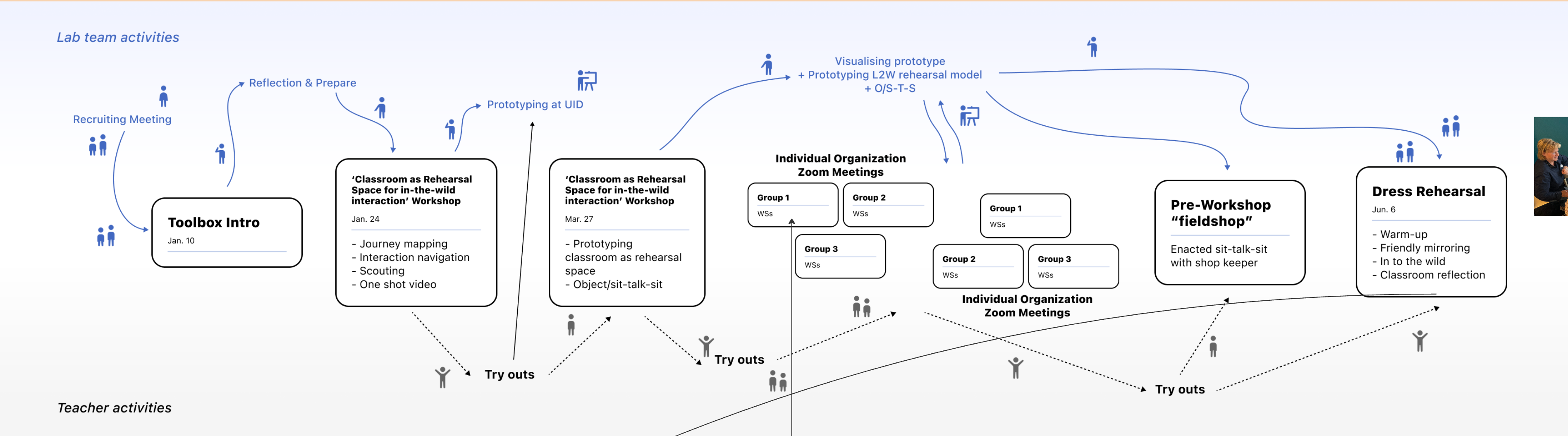
The Belgian project adopted a recurring cycle inspired by The Icelandic Village:
1) classroom preparation, (2) going out, exploring and interacting in the wild, and (3) reflection. The process was never treated as a simple teaching method, but as a broader shift in how teachers and learners understood language learning itself.
The first phase involved building relationships with language schools for adult education, municipal workers, local organizations, and civil servants in Genk. The project deliberately started on a small scale, following the advice of Scandinavian partners who emphasized that it would take time and support for teachers to move away from traditional “teaching language” approaches.
Workshops became central to the process. Teachers were introduced to materials from Språkskap and to experiential tools such as Journey Mapping, Interaction Navigator, Scouting, One-Shot Videos, Friendly Mirroring, and Sit-Talk-Sit. These activities encouraged teachers to rethink the role of the learner, shifting from passive absorption of language toward active exploration and interaction.
Journey Mapping, for example, was used to visualize a learner’s daily life and identify possible moments for interaction in Dutch. Teachers initially perceived the activity as abstract, but later began to understand it differently. One teacher realized that the activity was not an end in itself, but a way “to broaden the horizon for language students by looking for new potential situations to communicate in Dutch while doing their daily business.”
The project also experimented heavily with staging and rehearsal. During one workshop, the room was transformed into a “German library” where teachers themselves became language learners through a Sit-Talk-Sit sequence. They prepared interactions, entered the simulated environment, became overwhelmed or lost during the interaction, and then reflected together afterward. Through this exercise, teachers experienced firsthand the unpredictability and emotional pressure of speaking in another language.
Objects became important interactional supports. Teachers explored how ordinary things — books, groceries, pineapples, shopping lists — could structure and sustain conversations in the wild. One teacher later reflected on how even a pineapple could become the center of multiple interactions across supermarkets, recipes, and personal preferences.
As the project developed structurally within one language school, Taalarena evolved into a full 120-hour module for shortly educated adult learners at B1 level. Teachers began organizing recurring Sit-Talk-Sit trajectories where students selected meaningful topics from their own lives, explored them collectively in class, and then visited real environments such as parenting centers, schools, shops, libraries, or welfare services to interact in Dutch.
Reflection became continuous and social. Teachers stayed in touch with students through WhatsApp, sharing vocabulary and encouraging continued participation outside class. Students discussed their experiences together after each visit: what worked, what failed, what felt difficult, what they wanted to try next time.
Over time, teachers increasingly described themselves not as language instructors but as people who “give language support” while students themselves shaped the content through their own interests, struggles, and aspirations.
Instances
We never considered those situations meaningful before
During a scouting activity, teachers explored the school building and surrounding neighborhood in small groups. Many were surprised by how many resources for interaction already existed around them. One teacher, who previously only sent students to shops or train stations, realized that there was “a lot more information that you can tap into” in ordinary environments. Teachers described the activity as an “eye opener,” changing how they perceived everyday spaces.
The German Library
One workshop transformed the meeting room into a German library. Teachers who did not feel comfortable speaking German became the language learners themselves. They prepared questions about books, entered the interaction with the “librarian,” became confused when the conversation shifted unexpectedly, and later reflected together on how easily control disappeared during real interaction.
During reflection, teachers began proposing strategies they had never previously emphasized with students: cue cards, repetition, asking people to repeat themselves, using safe spaces inside shops, practicing support phrases repeatedly beforehand. One teacher reflected:

Something in your hands can help you feel more comfortable. It might not be perfect, but it could help you not to be afraid to speak.
The Pineapple
During a later workshop, one teacher casually mentioned buying a pineapple. The conversation expanded into a reflection on how even a simple object could generate multiple language situations: buying fresh pineapple versus canned pineapple, discussing recipes, asking questions in supermarkets, comparing preferences, or revisiting the same topic in different places.
Objects stopped being vocabulary items and became anchors for interaction.
Students Choosing Their Own Encounters
One teacher realized that she had previously controlled too much of the interaction process. Earlier, she selected the places students would visit and prescribed the questions they should ask. After experimenting with scouting and one-shot videos, she changed her approach and “let them choose for themselves what they found interesting to making pictures of.”
This revealed parts of students’ lives that had previously remained invisible to her: volunteering with elderly people, fitness centers, football games, hobbies, parenting activities, and informal conversations with other parents.
Some of them were afraid to make mistakes
Not all teachers embraced the shift immediately. Some continued using Journey Mapping mainly as a grammar exercise. One teacher asked students to describe their day while focusing on verb tenses and grammatical correctness. Afterwards, she observed that “some of them were afraid to make mistakes.”
This tension between language as controlled correctness and language as social participation remained a recurring challenge throughout the project.
Extra Work for Staff
The project depends on small, ongoing actions from staff within the kindergarten. They are expected to integrate language into daily interactions and support the cafés. At the same time, this expectation creates tension. “For some among them the feeling is that they are being asked to add extra work to their day-to-day routine, without getting a raise or thanks for that work.” The system relies on participation that is not always fully supported.
Why
The project responds to a gap between living in a society and being able to participate in it linguistically and socially.
As described,

L2 learners may live in the society without getting to know the locals,” pointing to a condition where presence does not automatically lead to connection. The intention is therefore to create opportunities for language learning that are embedded in social interaction, aiming “to help newcomers learn the language in a social context.
This also builds on and extends previous work, described as “to extend ‘The Icelandic Village’ – ie ‘learning in the wild’ in Iceland – with new target groups.” Beyond local implementation, the work contributes to a broader effort, seeking “to contribute to the projects’ working plan with sharing our expertise and tools.” Across these aims, language is not treated as an isolated skill but as something tied to participation, relationships, and everyday life.