Project Information
"The Icelandic Village" - the Icelandic approach to learning in the wild involves bringing L2W principles to new target groups, including foreign staff working in kindergartens and parents, and creating additional real-life learning opportunities.
The Icelandic Village is part of a broader initiative of L2W. This initiative enriches knowledge, methodology, and the repertoire of tools and experiences available for L2W, empowering newcomers to acquire language skills through authentic social interaction. By integrating these innovations and sharing expertise across project partners in Belgium, Denmark, and Iceland, the project advances its overarching objective: strengthening language learning and social inclusion for a broader range of participants, and enhancing teacher competence in language learning in-the-wild.
Guðlaug Stella Brynjólfsdóttir, Project Manager, The Icelandic Village
L2W in Kindergarten and local communities (Reykjavik)
Text here
Read More
→
What
The purpose of the Icelandic Work Package is to support learning Icelandic in the Wild by building a community for parents from different countries in kindergartens and on strengthening communication and the flow of information in Icelandic between staff and parents.
The focus is very specific:

Kindergarten can be regarded as a gateway to Icelandic society.
For many parents, the kindergarten can be the only place where they come in contact with Icelanders, Icelandic customs, Icelandic traditions and of course the Icelandic language. This is not incidental. It is structural. Immigrants are now about 25% of people in the labour market – 18% of the population in the country – and a large majority of the immigrants assess their ability of speaking Icelandic as nearly non-existent.
The work positions parents not just as learners, but as actors shaping the future: A parent that learns the language of the country is in a better position to support its child or children in becoming active and empowered members of the society.
Leirtjörn
Úlfarsfell


Reykjavík
Challenges in language learning in Iceland
Iceland’s growing immigrant population has increased the need for Icelandic language learning. In kindergartens, staff come from diverse linguistic backgrounds, and only a few speak both English and Icelandic. Communication often relies on gestures, leaving parents hesitant to talk and reluctant to engage due to language barriers.
How
The project intended to create language cafés for L2 parents and staff at two nursery/-kindergarten in the city center of Reykjavík. These are lightweight but intentional; the Language Cafés should take place once a fortnight – and each café should last about 45 minutes.
The system depends on the everyday:

We rely on the staff to remind the L2 learners among the parents about the Language Cafés and to speak Icelandic to them as well as pointing out the sentence of the week etc.
But this comes with friction:
For some among them the feeling is that they are being asked to add extra work to their day-to-day routine, without getting a raise or thanks for that work. So the method expands beyond cafés into preparation and co-design.
Understanding the context
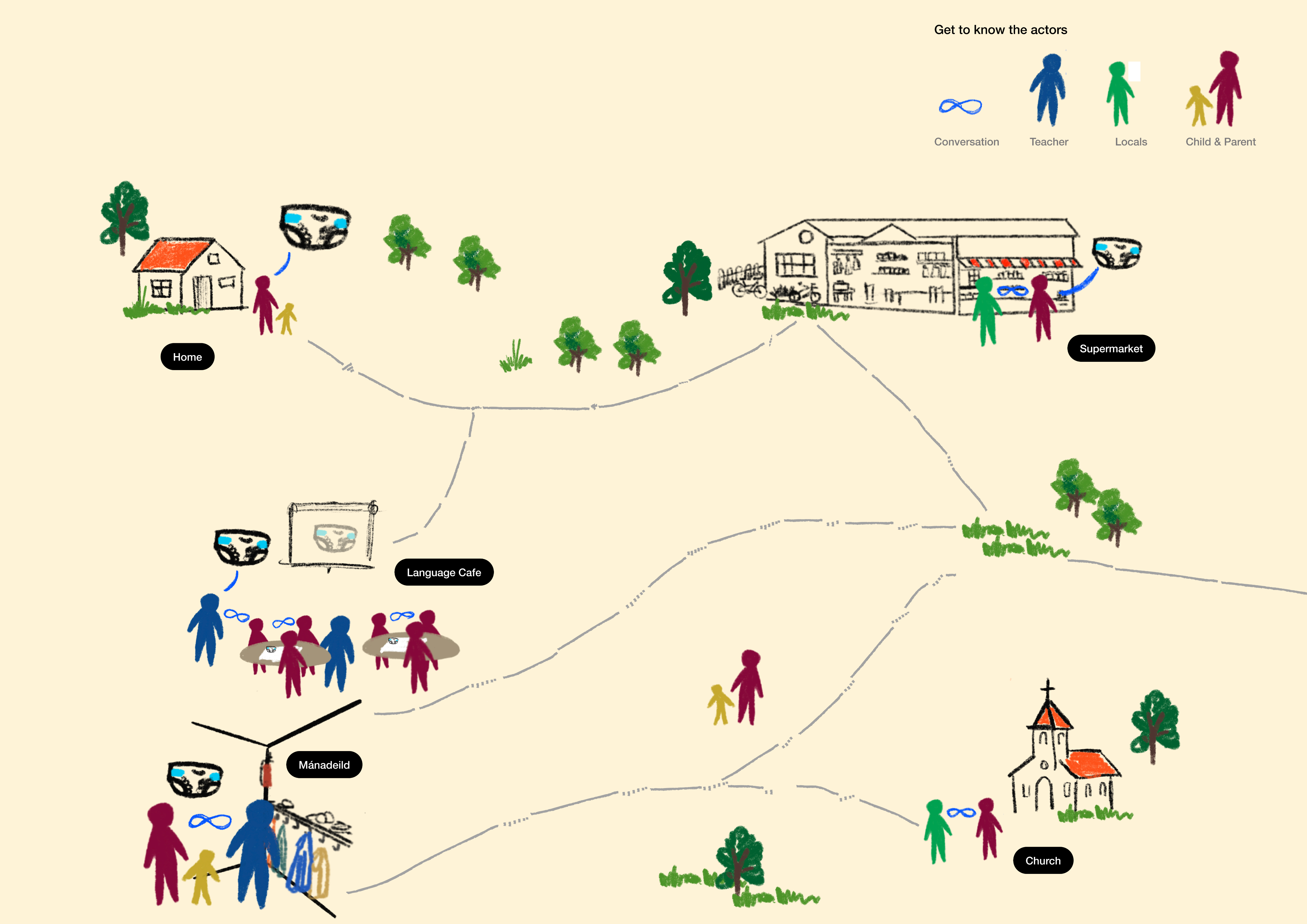
Key staff members were a part of the development process from the beginning. There were five months of preparation with key staff members, with meetings two times per month where we form, plan, try out, reflect and discuss the program, and eight workshops for all staff members at the kindergarten. The workshops aimed to raise awareness of multilingualism, multiculturalism, the role of home languages, and language learning through interaction in everyday contexts, to build a community where parents of other origin feel safe to use and practice Icelandic, and to educate staff about language learning through communication in real-life situations. The work included identifying places and topics where you speak with parents and building and scaffolding interactions, where, what, with whom, as well as celebrating what the staff have tried out by locating their experiences on the map and in action. As there was no ready-made material, we developed a series of short stories and related learning activities about everyday life in the kindergarten, designed to reflect the authentic experiences, interactions, and language use that take place within the kindergarten community and in Icelandic society.
The work also focuses on identifying and shaping everyday interaction points, including “places and topics where you speak with parents” and “building and scaffolding interactions – where, what, with whom.” Since no ready-made materials existed, “we had to develop our own material,” resulting in “a series of short stories and related learning activities about everyday life in the kindergarten,” designed to reflect “authentic experiences, interactions, and language use… within the kindergarten community and in the Icelandic society.
Instances
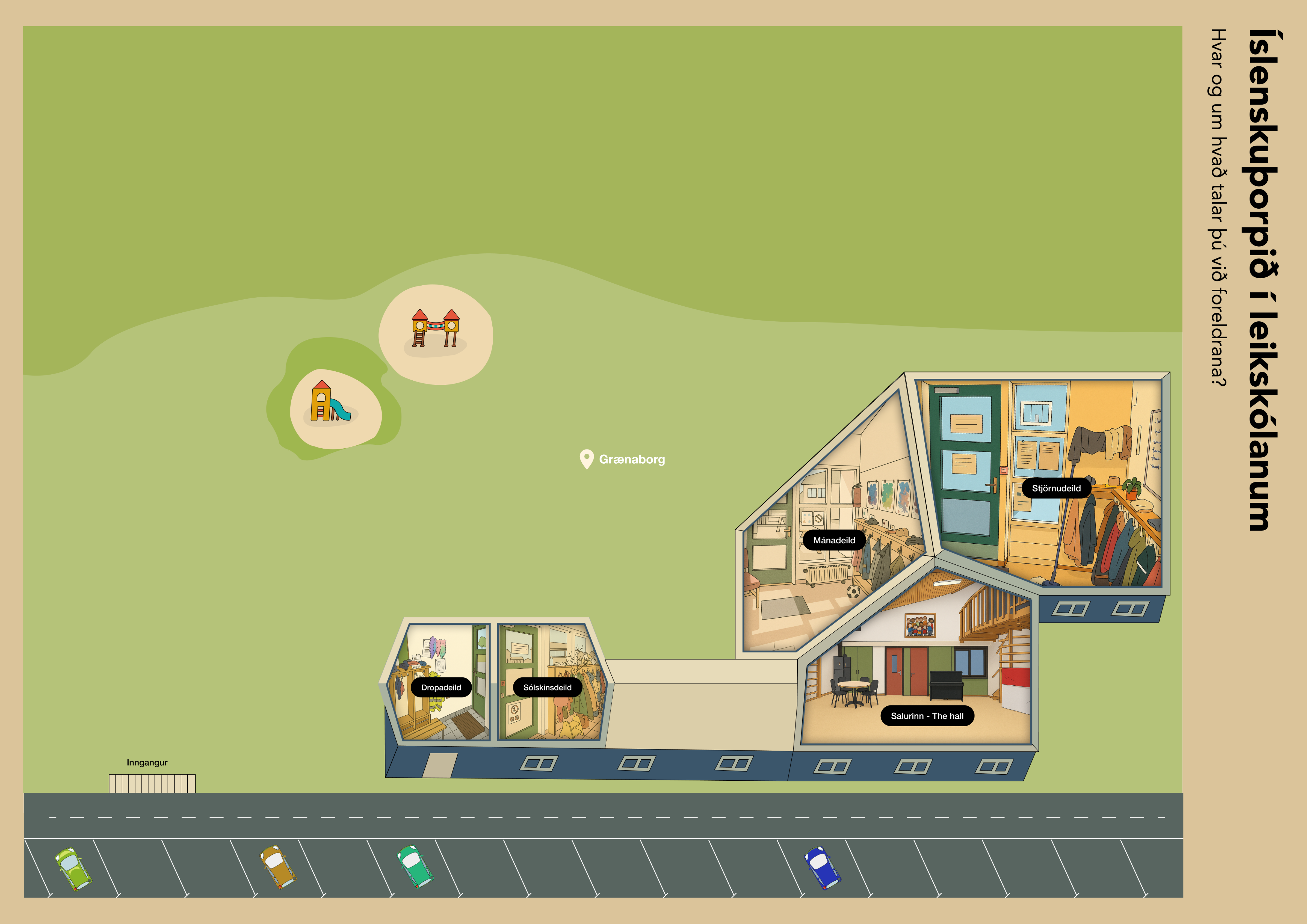
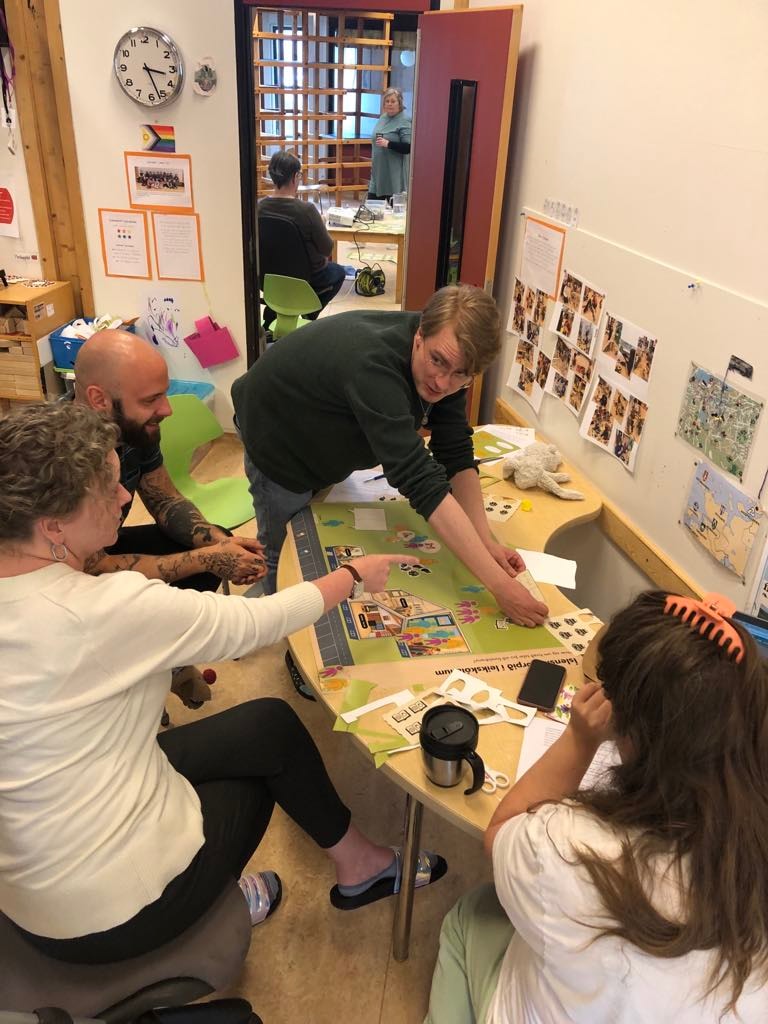
May 5th, 2025 Workshop at Grænaborg Kindergartern
21 staff members gathered for a two-hour workshop designed to foster engagement and creativity. The session began with the playful warm-up Glaðispegillinn, before moving into reflective questions such as “Who did you talk to?” and “Where were you?”. Working in groups of three, participants used shared maps and play materials to create short role-plays, each given a unique title and marked with name tags. Staff noted that open communication can help parents feel more confident, more autonomous, and ultimately more integrated into both the preschool and the wider Icelandic-speaking community.
Kindergarten Drops Out
The project begins with a shift in scope. Two kindergartens were part of the initial plan, but this changed once the work met everyday constraints. “There is no budget for overtime for the staff,” and the added responsibility of running language cafés and participating in workshops placed pressure on already full schedules. This led to a concrete outcome: “one of the original two play schools dropped out of the project.” What remains is shaped by what institutions can realistically sustain.
Unpredictable Attendance
The language cafés never settle into a fixed rhythm. Each session depends on who is able to show up that day. “We never know how many will show up,” and “attendance has therefore been fluctuating up and down.” Rather than a stable group progressing together, every اللقاء becomes a new configuration, requiring constant adjustment.
Different Levels in the Same Room
Participation brings together parents with very different relationships to Icelandic. “Some parents have high proficiency… while others know next to nothing.” This creates situations where understanding is uneven, and conversations stretch across multiple levels at once. The same interaction must hold both fluency and hesitation.
Distance Between Languages
Language backgrounds shape how easily parents can enter into interaction. “Some come from other Nordic countries,” where similarities offer partial familiarity, while others “are from South-East Asia or Africa where the language is completely different.” The gap between languages becomes visible in how quickly or slowly participation unfolds.
No Time, Limited Energy
Participation is constrained by everyday life. Parents are not entering a neutral learning environment; they arrive within already demanding routines. “Parents with toddlers… don’t have a lot of extra time and energy. Their life is stressful as it is.” Engagement is shaped as much by exhaustion as by motivation.
Extra Work for Staff
The project depends on small, ongoing actions from staff within the kindergarten. They are expected to integrate language into daily interactions and support the cafés. At the same time, this expectation creates tension. “For some among them the feeling is that they are being asked to add extra work to their day-to-day routine, without getting a raise or thanks for that work.” The system relies on participation that is not always fully supported.
🇮🇸
Iceland
Project Information
Guðlaug Stella Brynjólfsdóttir,
Project Manager, The Icelandic Village
"The Icelandic Village" - the Icelandic approach to learning in the wild involves bringing L2W principles to new target groups, including foreign staff working in kindergartens and parents, and creating additional real-life learning opportunities.
The Icelandic Village is part of a broader initiative of L2W. This initiative enriches knowledge, methodology, and the repertoire of tools and experiences available for L2W, empowering newcomers to acquire language skills through authentic social interaction. By integrating these innovations and sharing expertise across project partners in Belgium, Denmark, and Iceland, the project advances its overarching objective: strengthening language learning and social inclusion for a broader range of participants, and enhancing teacher competence in language learning in-the-wild.
L2W in Kindergarten and local communities (Reykjavik)
Read More
→
What
The purpose of the Icelandic Work Package is to support learning Icelandic in the Wild by building a community for parents from different countries in kindergartens and on strengthening communication and the flow of information in Icelandic between staff and parents.
The focus is very specific:

Kindergarten can be regarded as a gateway to Icelandic society.
For many parents, the kindergarten can be the only place where they come in contact with Icelanders, Icelandic customs, Icelandic traditions and of course the Icelandic language. This is not incidental. It is structural. Immigrants are now about 25% of people in the labour market – 18% of the population in the country – and a large majority of the immigrants assess their ability of speaking Icelandic as nearly non-existent.
The work positions parents not just as learners, but as actors shaping the future: A parent that learns the language of the country is in a better position to support its child or children in becoming active and empowered members of the society.
Challenges and Opportunities
Leirtjörn
Úlfarsfell


Reykjavík
Challenges in language learning in Iceland
Iceland’s growing immigrant population has increased the need for Icelandic language learning. In kindergartens, staff come from diverse linguistic backgrounds, and only a few speak both English and Icelandic. Communication often relies on gestures, leaving parents hesitant to talk and reluctant to engage due to language barriers.
How
The project intended to create language cafés for L2 parents and staff at two nursery/-kindergarten in the city center of Reykjavík. These are lightweight but intentional; the Language Cafés should take place once a fortnight – and each café should last about 45 minutes.
The system depends on the everyday:

We rely on the staff to remind the L2 learners among the parents about the Language Cafés and to speak Icelandic to them as well as pointing out the sentence of the week etc.
But this comes with friction:
For some among them the feeling is that they are being asked to add extra work to their day-to-day routine, without getting a raise or thanks for that work. So the method expands beyond cafés into preparation and co-design.
Understanding the context
Key staff members were a part of the development process from the beginning. There were five months of preparation with key staff members, with meetings two times per month where we form, plan, try out, reflect and discuss the program, and eight workshops for all staff members at the kindergarten. The workshops aimed to raise awareness of multilingualism, multiculturalism, the role of home languages, and language learning through interaction in everyday contexts, to build a community where parents of other origin feel safe to use and practice Icelandic, and to educate staff about language learning through communication in real-life situations. The work included identifying places and topics where you speak with parents and building and scaffolding interactions, where, what, with whom, as well as celebrating what the staff have tried out by locating their experiences on the map and in action. As there was no ready-made material, we developed a series of short stories and related learning activities about everyday life in the kindergarten, designed to reflect the authentic experiences, interactions, and language use that take place within the kindergarten community and in Icelandic society.
The work also focuses on identifying and shaping everyday interaction points, including “places and topics where you speak with parents” and “building and scaffolding interactions – where, what, with whom.” Since no ready-made materials existed, “we had to develop our own material,” resulting in “a series of short stories and related learning activities about everyday life in the kindergarten,” designed to reflect “authentic experiences, interactions, and language use… within the kindergarten community and in the Icelandic society.
Instances
May 5th, 2025 Workshop at Grænaborg Kindergartern
21 staff members gathered for a two-hour workshop designed to foster engagement and creativity. The session began with the playful warm-up Glaðispegillinn, before moving into reflective questions such as “Who did you talk to?” and “Where were you?”. Working in groups of three, participants used shared maps and play materials to create short role-plays, each given a unique title and marked with name tags. Staff noted that open communication can help parents feel more confident, more autonomous, and ultimately more integrated into both the preschool and the wider Icelandic-speaking community.
Kindergarten Drops Out
The project begins with a shift in scope. Two kindergartens were part of the initial plan, but this changed once the work met everyday constraints. “There is no budget for overtime for the staff,” and the added responsibility of running language cafés and participating in workshops placed pressure on already full schedules. This led to a concrete outcome: “one of the original two play schools dropped out of the project.” What remains is shaped by what institutions can realistically sustain.
Unpredictable Attendance
The language cafés never settle into a fixed rhythm. Each session depends on who is able to show up that day. “We never know how many will show up,” and “attendance has therefore been fluctuating up and down.” Rather than a stable group progressing together, every اللقاء becomes a new configuration, requiring constant adjustment.
Different Levels in the Same Room
Participation brings together parents with very different relationships to Icelandic. “Some parents have high proficiency… while others know next to nothing.” This creates situations where understanding is uneven, and conversations stretch across multiple levels at once. The same interaction must hold both fluency and hesitation.
Distance Between Languages
Language backgrounds shape how easily parents can enter into interaction. “Some come from other Nordic countries,” where similarities offer partial familiarity, while others “are from South-East Asia or Africa where the language is completely different.” The gap between languages becomes visible in how quickly or slowly participation unfolds.
No Time, Limited Energy
Participation is constrained by everyday life. Parents are not entering a neutral learning environment; they arrive within already demanding routines. “Parents with toddlers… don’t have a lot of extra time and energy. Their life is stressful as it is.” Engagement is shaped as much by exhaustion as by motivation.
Extra Work for Staff
The project depends on small, ongoing actions from staff within the kindergarten. They are expected to integrate language into daily interactions and support the cafés. At the same time, this expectation creates tension. “For some among them the feeling is that they are being asked to add extra work to their day-to-day routine, without getting a raise or thanks for that work.” The system relies on participation that is not always fully supported.
Why
The project responds to a gap between living in a society and being able to participate in it linguistically and socially. As described,
As described,

L2 learners may live in the society without getting to know the locals,” pointing to a condition where presence does not automatically lead to connection. The intention is therefore to create opportunities for language learning that are embedded in social interaction, aiming “to help newcomers learn the language in a social context.
This also builds on and extends previous work, described as “to extend ‘The Icelandic Village’ – ie ‘learning in the wild’ in Iceland – with new target groups.” Beyond local implementation, the work contributes to a broader effort, seeking “to contribute to the projects’ working plan with sharing our expertise and tools.” Across these aims, language is not treated as an isolated skill but as something tied to participation, relationships, and everyday life.
🇮🇸
Iceland
Project Information
Guðlaug Stella Brynjólfsdóttir,
Project Manager, The Icelandic Village
"The Icelandic Village" - the Icelandic approach to learning in the wild involves bringing L2W principles to new target groups, including foreign staff working in kindergartens and parents, and creating additional real-life learning opportunities.
The Icelandic Village is part of a broader initiative of L2W. This initiative enriches knowledge, methodology, and the repertoire of tools and experiences available for L2W, empowering newcomers to acquire language skills through authentic social interaction. By integrating these innovations and sharing expertise across project partners in Belgium, Denmark, and Iceland, the project advances its overarching objective: strengthening language learning and social inclusion for a broader range of participants, and enhancing teacher competence in language learning in-the-wild.
L2W in Kindergarten and local communities (Reykjavik)
Read More
→
What
The purpose of the Icelandic Work Package is to support learning Icelandic in the Wild by building a community for parents from different countries in kindergartens and on strengthening communication and the flow of information in Icelandic between staff and parents.
The focus is very specific:

Kindergarten can be regarded as a gateway to Icelandic society.
For many parents, the kindergarten can be the only place where they come in contact with Icelanders, Icelandic customs, Icelandic traditions and of course the Icelandic language. This is not incidental. It is structural. Immigrants are now about 25% of people in the labour market – 18% of the population in the country – and a large majority of the immigrants assess their ability of speaking Icelandic as nearly non-existent.
The work positions parents not just as learners, but as actors shaping the future: A parent that learns the language of the country is in a better position to support its child or children in becoming active and empowered members of the society.
Challenges and Opportunities
Leirtjörn
Úlfarsfell

Reykjavík
Challenges in language learning in Iceland
Iceland’s growing immigrant population has increased the need for Icelandic language learning. In kindergartens, staff come from diverse linguistic backgrounds, and only a few speak both English and Icelandic. Communication often relies on gestures, leaving parents hesitant to talk and reluctant to engage due to language barriers.
How
The project intended to create language cafés for L2 parents and staff at two nursery/-kindergarten in the city center of Reykjavík. These are lightweight but intentional; the Language Cafés should take place once a fortnight – and each café should last about 45 minutes.
The system depends on the everyday:
We rely on the staff to remind the L2 learners among the parents about the Language Cafés and to speak Icelandic to them as well as pointing out the sentence of the week etc.
But this comes with friction:
For some among them the feeling is that they are being asked to add extra work to their day-to-day routine, without getting a raise or thanks for that work. So the method expands beyond cafés into preparation and co-design.
Understanding the context
Key staff members were a part of the development process from the beginning. There were five months of preparation with key staff members, with meetings two times per month where we form, plan, try out, reflect and discuss the program, and eight workshops for all staff members at the kindergarten. The workshops aimed to raise awareness of multilingualism, multiculturalism, the role of home languages, and language learning through interaction in everyday contexts, to build a community where parents of other origin feel safe to use and practice Icelandic, and to educate staff about language learning through communication in real-life situations. The work included identifying places and topics where you speak with parents and building and scaffolding interactions, where, what, with whom, as well as celebrating what the staff have tried out by locating their experiences on the map and in action. As there was no ready-made material, we developed a series of short stories and related learning activities about everyday life in the kindergarten, designed to reflect the authentic experiences, interactions, and language use that take place within the kindergarten community and in Icelandic society.
The work also focuses on identifying and shaping everyday interaction points, including “places and topics where you speak with parents” and “building and scaffolding interactions – where, what, with whom.” Since no ready-made materials existed, “we had to develop our own material,” resulting in “a series of short stories and related learning activities about everyday life in the kindergarten,” designed to reflect “authentic experiences, interactions, and language use… within the kindergarten community and in the Icelandic society.
Instances
May 5th, 2025 Workshop at Grænaborg Kindergartern
21 staff members gathered for a two-hour workshop designed to foster engagement and creativity. The session began with the playful warm-up Glaðispegillinn, before moving into reflective questions such as “Who did you talk to?” and “Where were you?”. Working in groups of three, participants used shared maps and play materials to create short role-plays, each given a unique title and marked with name tags. Staff noted that open communication can help parents feel more confident, more autonomous, and ultimately more integrated into both the preschool and the wider Icelandic-speaking community.
Kindergarten Drops Out
The project begins with a shift in scope. Two kindergartens were part of the initial plan, but this changed once the work met everyday constraints. “There is no budget for overtime for the staff,” and the added responsibility of running language cafés and participating in workshops placed pressure on already full schedules. This led to a concrete outcome: “one of the original two play schools dropped out of the project.” What remains is shaped by what institutions can realistically sustain.
Unpredictable Attendance
The language cafés never settle into a fixed rhythm. Each session depends on who is able to show up that day. “We never know how many will show up,” and “attendance has therefore been fluctuating up and down.” Rather than a stable group progressing together, every اللقاء becomes a new configuration, requiring constant adjustment.
Different Levels in the Same Room
Participation brings together parents with very different relationships to Icelandic. “Some parents have high proficiency… while others know next to nothing.” This creates situations where understanding is uneven, and conversations stretch across multiple levels at once. The same interaction must hold both fluency and hesitation.
Distance Between Languages
Language backgrounds shape how easily parents can enter into interaction. “Some come from other Nordic countries,” where similarities offer partial familiarity, while others “are from South-East Asia or Africa where the language is completely different.” The gap between languages becomes visible in how quickly or slowly participation unfolds.
No Time, Limited Energy
Participation is constrained by everyday life. Parents are not entering a neutral learning environment; they arrive within already demanding routines. “Parents with toddlers… don’t have a lot of extra time and energy. Their life is stressful as it is.” Engagement is shaped as much by exhaustion as by motivation.
Extra Work for Staff
The project depends on small, ongoing actions from staff within the kindergarten. They are expected to integrate language into daily interactions and support the cafés. At the same time, this expectation creates tension. “For some among them the feeling is that they are being asked to add extra work to their day-to-day routine, without getting a raise or thanks for that work.” The system relies on participation that is not always fully supported.
Why
The project responds to a gap between living in a society and being able to participate in it linguistically and socially.
As described,
L2 learners may live in the society without getting to know the locals,” pointing to a condition where presence does not automatically lead to connection. The intention is therefore to create opportunities for language learning that are embedded in social interaction, aiming “to help newcomers learn the language in a social context.
This also builds on and extends previous work, described as “to extend ‘The Icelandic Village’ – ie ‘learning in the wild’ in Iceland – with new target groups.” Beyond local implementation, the work contributes to a broader effort, seeking “to contribute to the projects’ working plan with sharing our expertise and tools.” Across these aims, language is not treated as an isolated skill but as something tied to participation, relationships, and everyday life.