Project Information
How can educators and learners notice, understand, and learn from the unpredictable and often fleeting moments of language use that occur outside the classroom?
Within the Erasmus+ project Language Learning in the Wild (L2W, 2023–2026), the Hybrid Collaborative Design Lab, led by Brendon Clark at Umeå Institute of Design, brings together researchers, practitioners, teachers, and learners to explore how language learning happens in everyday life, and to support them in developing their own local language learning in-the-wild approach. Building on earlier Scandinavian initiatives, the lab provides tools, formats, shared spaces, and guidance where participants can develop and test approaches suited to their own local contexts, while reflecting together on emerging challenges and opportunities.
Learning “in the wild” shifts the focus away from language as a fixed system of rules and vocabulary, and toward how language is actually used in real-life situations. It emphasizes how people make meaning through interactions with others, objects, and environments in the flow of daily life. This shift brings new challenges: how can educators and learners notice, understand, and learn from the unpredictable and often fleeting moments of language use that occur outside the classroom?
To address this, co-design plays a central role. In L2W, co-design is about making the complexity of real-world language use visible and workable. Through simple physical and visual materials, participants create representations of past and possible future situations “in the wild,” exploring how interactions unfold in practice: where they happen, who is involved, and what tools and environments are part of them. These material explorations support richer discussions and open-up new ways of thinking about language learning how to support learning, reframing it as an active processes of learning-by-doing.
While traditional research offers detailed insights into how people interact and learn, these are often presented in dense academic texts. Co-design complements this by creating practical, accessible platforms for exploring interactions as they unfold, as well as reflecting on them afterward. These temporary structures help participants attend to the relationships between people, objects, and spaces, and to connect past experiences, present situations, and future possibilities, supporting ongoing reflection, learning, and action.
Brendon Clark , Project Manager, Hybrid Collaborative Design Lab
Collaborative Design as a practical approach for supporting Language Learning in the Wild
Read More
→
The Hybrid Co-Design Lab operated through two overlapping streams of activities that supported knowledge sharing and development during ongoing project activities:
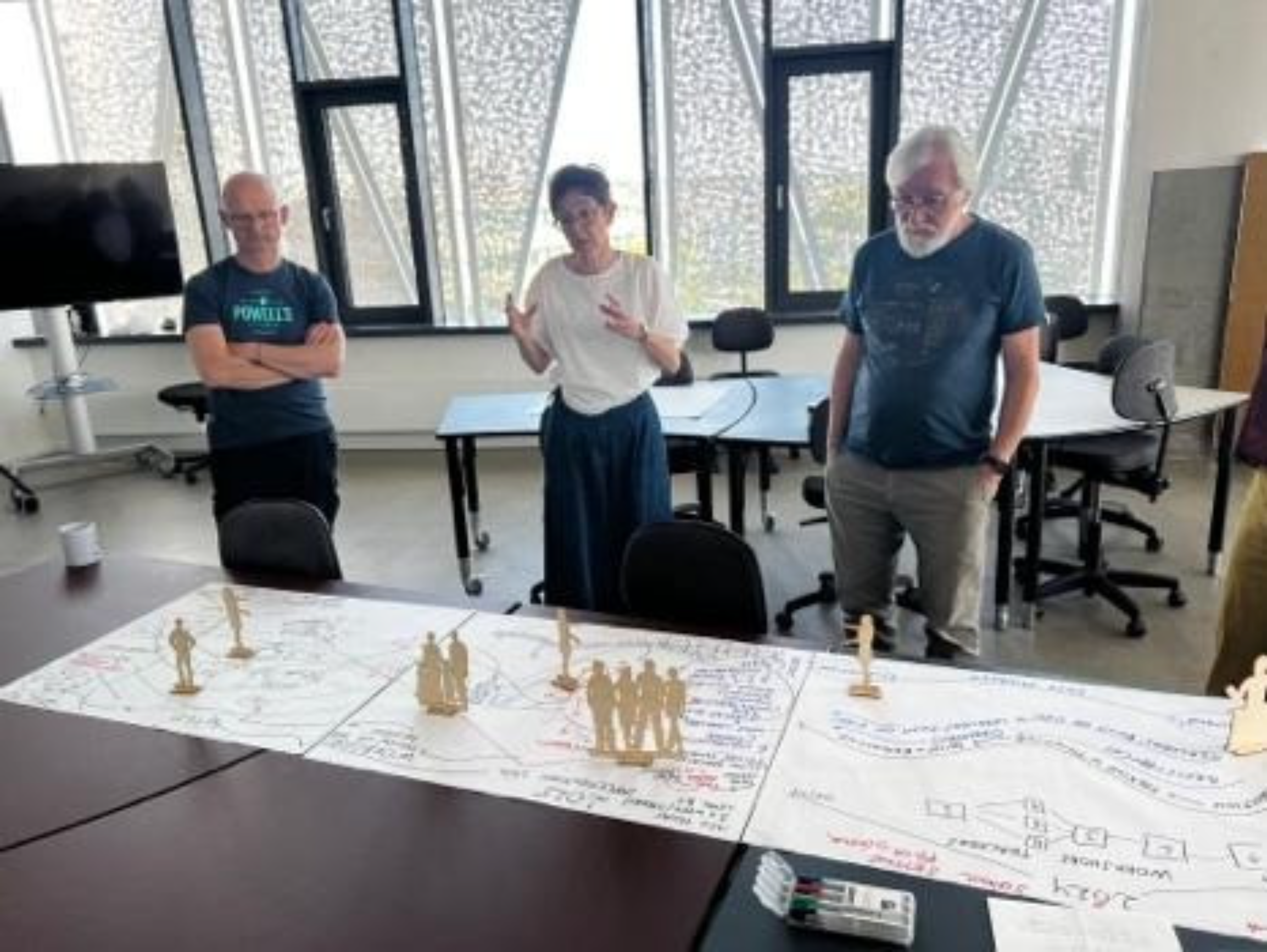
- Cross-partner collaboration: Researchers and practitioners from each country met regularly throughout the project, both in annual in-person gatherings across Iceland, Sweden, Denmark, and Belgium, and in regular online meetings. Co-design was used to support making each initiative’s work visible and tangible, supporting shared reflection on challenges, opportunities, and future directions.
- Cross-partner collaboration: Researchers and practitioners from each country met regularly throughout the project, both in annual in-person gatherings across Iceland, Sweden, Denmark, and Belgium, and in regular online meetings. Co-design was used to support making each initiative’s work visible and tangible, supporting shared reflection on challenges, opportunities, and future directions.
Supporting technologies and demonstrator
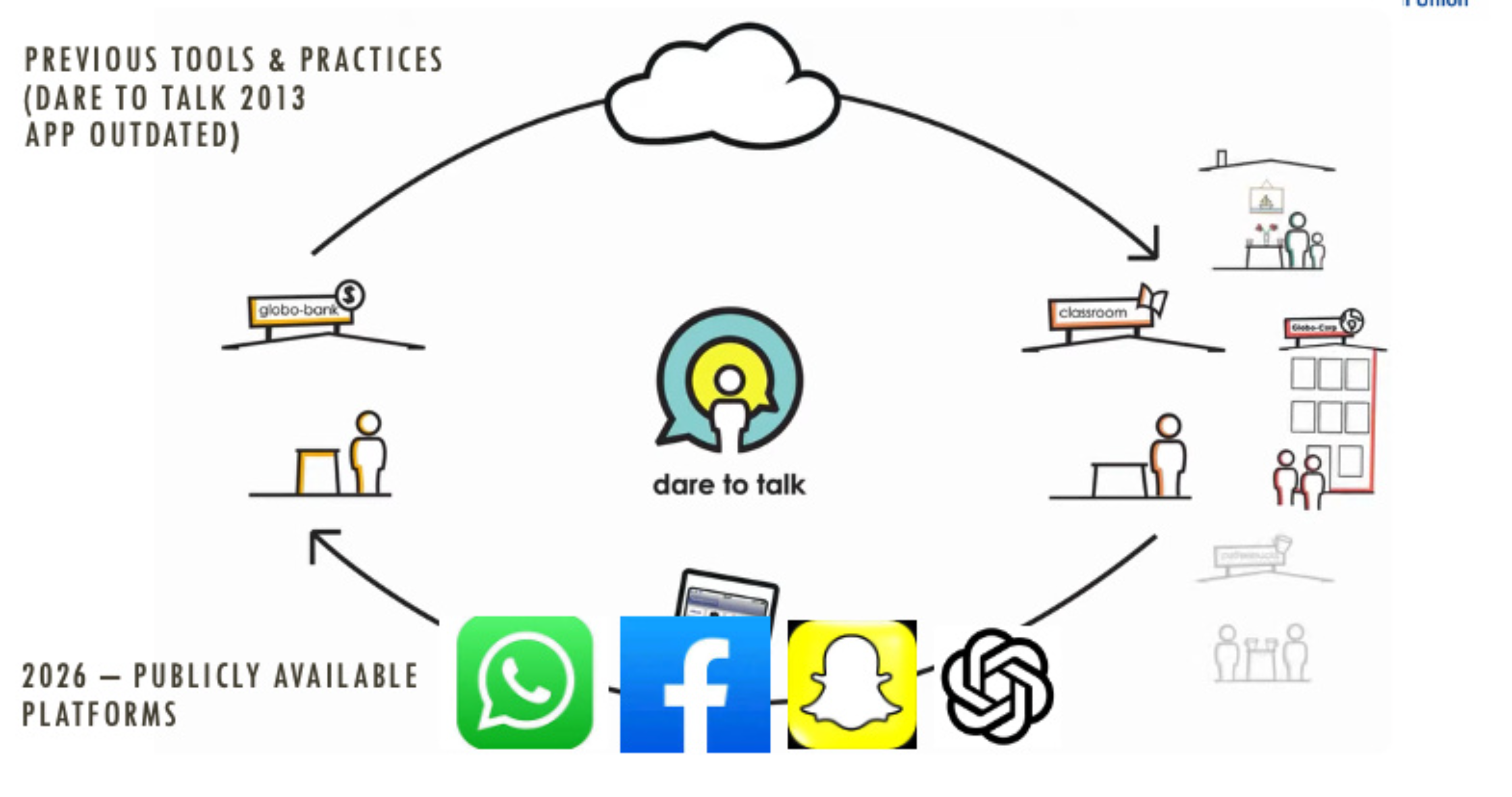
The Dare-to-Talk app is an example of a concept and a now outdated smart phone app, that can now be replaced by readily available technology. At the same time, the concept relies upon new forms of organizing experiential learning activities to become valuable.
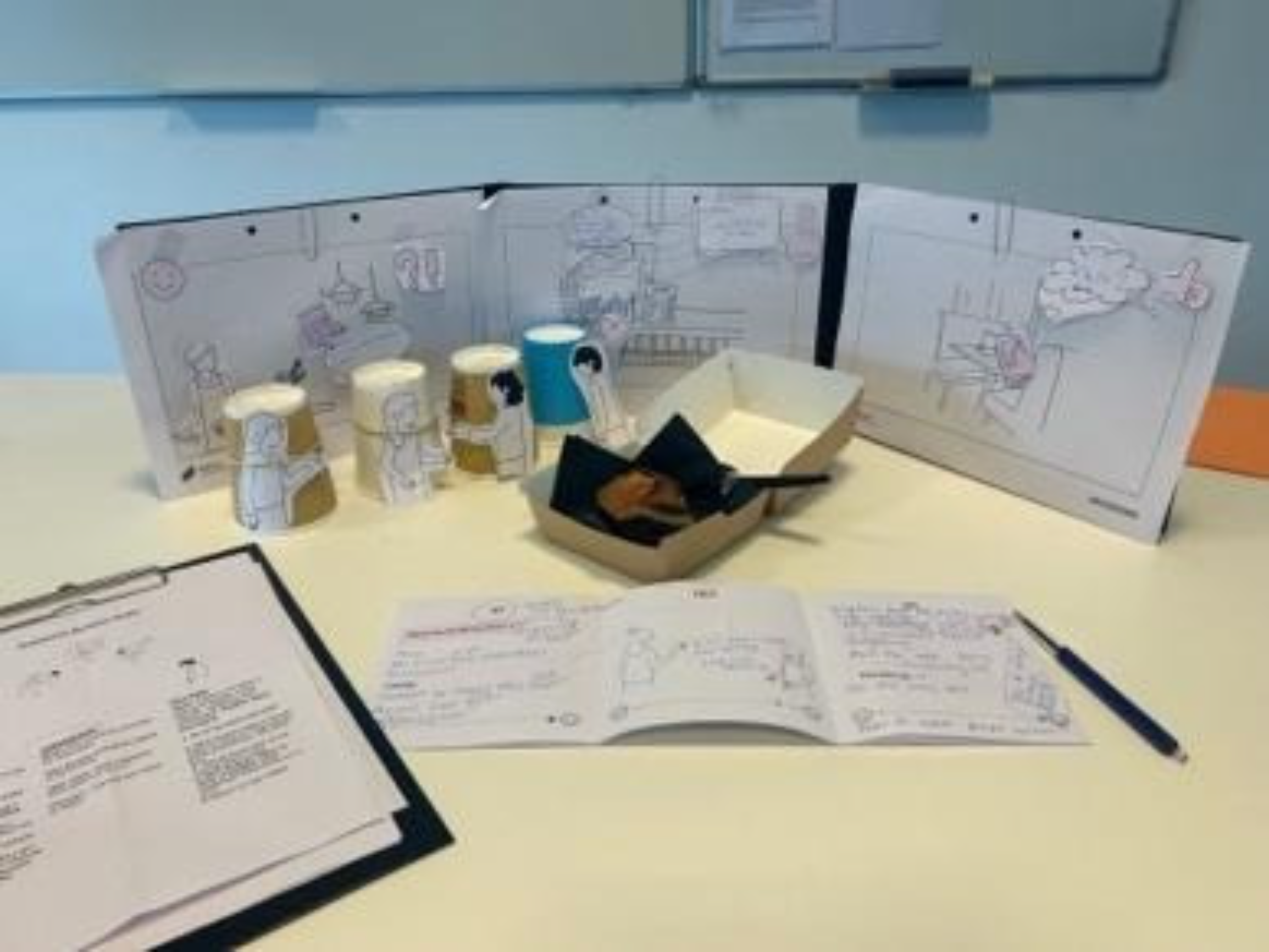
Examples of the Hybrid Collaborative Design Lab activities:
Repository of tools & inspiration:
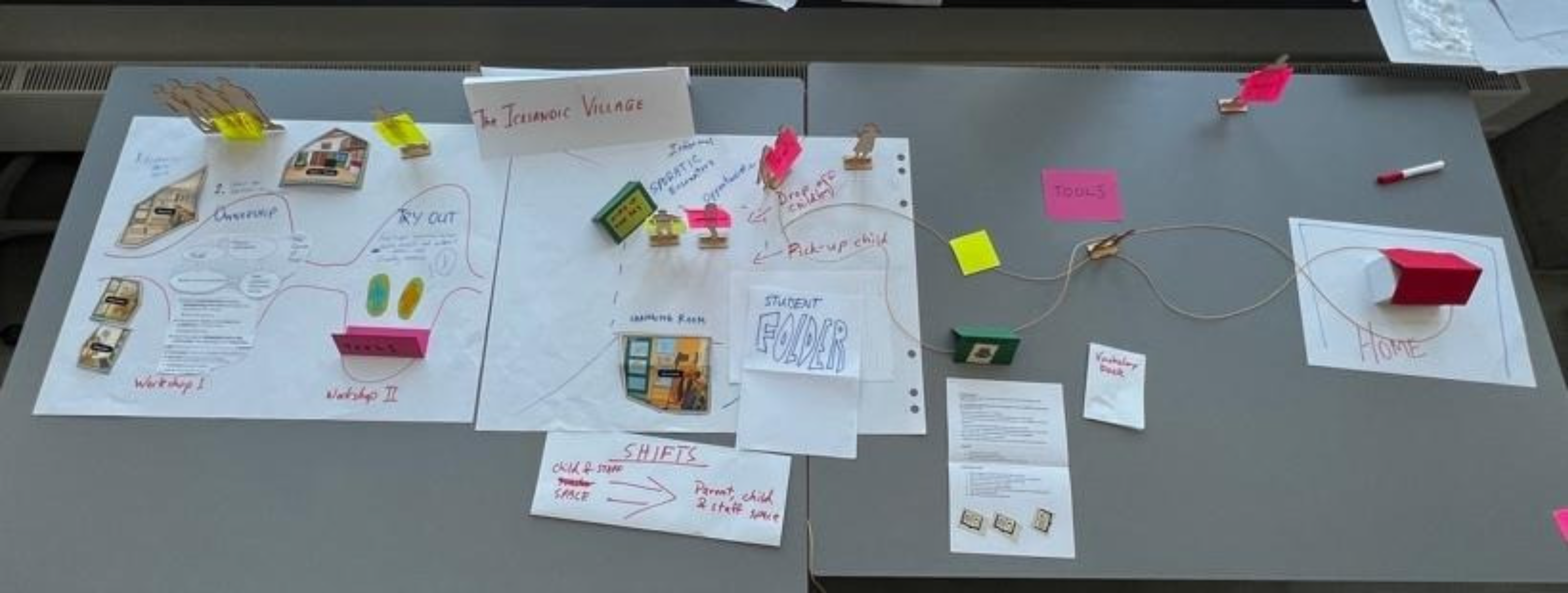
The lab draws on a repertoire of research and practice developed in the language learning in the wild network partners such as the Språkskap vision and Sit-talk-Sit experiential learning model, The Icelandic Village as a network of local business where students can try out their Icelandic combined with analyzing those interactions in the classroom, and Finnish in the Wild supporting the co-design of out-side-the-classroom learning tasks. Select tools and inspiration from this repertoire are introduced through workshop activities, sequenced to support a learning-by-doing approach for educators, as basis of developing their own approach. For instance, the publication Co-creating language learning journeys: A designerly approach to supporting experiential language learning practices (Clark & Torretta 2018) introduces a selection of tools that have been developed through these previous initiatives.
The lab draws on a repertoire of research and practice developed in the language learning in the wild network partners such as the Språkskap vision and Sit-talk-Sit experiential learning model, The Icelandic Village as a network of local business where students can try out their Icelandic combined with analyzing those interactions in the classroom, and Finnish in the Wild supporting the co-design of out-side-the-classroom learning tasks. Select tools and inspiration from this repertoire are introduced through workshop activities, sequenced to support a learning-by-doing approach for educators, as basis of developing their own approach. For instance, the publication Co-creating language learning journeys: A designerly approach to supporting experiential language learning practices (Clark & Torretta 2018) introduces a selection of tools that have been developed through these previous initiatives.
- Mapping daily interactions (Journey Mapping, Photo Diary)
- Identifying opportunities (Scouting, My Places, Network Map)
- Structuring interactions (Sit-talk-Sit, Interaction Navigator)
- Expanding conversations (Expander)
- Documenting and reflecting (One-shot video)
These tools have been developed and used to support learners turn everyday experiences into objects of reflection and learning, yet they often do not work alone, nor do they fit nicely into language teaching activities. Instead, they are introduced to educators through workshop activities that emphasize the need to try-out and reflect upon their value, and how they may become valuable within a sequence of activities. Each effort to introduce these tools, triggers the development of new tools to further support the issues that arise.
Taalarena Co-lab
Another recurring example is the Sit–Talk–Sit structure. Developed as a simple scaffold for participation, it organizes learning into three stages: preparation, interaction, and reflection. Learners prepare for an encounter, engage in a real interaction, and then pause to review what occurred. The value of the model lies in its simplicity and adaptability across contexts. As the authors note, it provides "a manageable rhythm that can be repeated across situations without prescribing exactly what should happen."
Another recurring example is the Sit–Talk–Sit structure. Developed as a simple scaffold for participation, it organizes learning into three stages: preparation, interaction, and reflection. Learners prepare for an encounter, engage in a real interaction, and then pause to review what occurred. The value of the model lies in its simplicity and adaptability across contexts. As the authors note, it provides "a manageable rhythm that can be repeated across situations without prescribing exactly what should happen."

- Top layer (Lab team activities): design, facilitation, and support work conducted by the lab and co-design team.
- Middle layer (Collaborative activities): workshops and shared experiments involving both teachers and the lab team.
- Bottom layer (Teacher activities): situated practices carried out by teachers within their own educational contexts.
Another recurring example is the Sit–Talk–Sit structure. Developed as a simple scaffold for participation, it organizes learning into three stages: preparation, interaction, and reflection. Learners prepare for an encounter, engage in a real interaction, and then pause to review what occurred. The value of the model lies in its simplicity and adaptability across contexts. As the authors note, it provides "a manageable rhythm that can be repeated across situations without prescribing exactly what should happen."
Staging a mock German Library for Dutch teachers (the classroom as rehearsal space)
After initial exposure to tools and inspiration about L2W, we sought to create an experience that could bring more appreciation to both the challenges that learners face “in-the-wild”, but also to appreciate the use of objects and scaffolding to support those challenges. The local coordinator, with remote support from the co-lab team, staged and facilitated a workshop where the Dutch teachers would try out a sit-talk-sit sequence in relation to a mock-German library. The coordinator brought about 20 German books, asked the most fluent German speaking teacher to play the role of the librarian, and staged a sequence of the “learner” finding an object (in this case a book), developing questions in German and warming-up with two others as support, then standing-up, walking to the librarian design and talking with her, and returning the other two to reflect on how it went. Upon reflection on the workshop activity, some teachers reported that it was only then that they understood the approach.
A defining feature of the Co-Lab model is the oscillation between collective experimentation and situated enactment. The co-design role moves between facilitating shared workshops and supporting localized adaptations, while also enabling rapid production of both physical and digital materials that mediate this process. In doing so, the lab creates conditions for teachers not only to experience tools such as Sit-talk-Sit or Journey Mapping, but to test, combine, and reconfigure them into meaningful sequences of activities.
Extending the Icelandic Village – Transforming a public service into an arena for in-the-wild learning

The Icelandic case can be understood as a concrete instantiation of the Co-Lab model, where activities unfold across three interrelated layers: lab facilitation (top), collaborative workshops (middle), and situated teacher practice (bottom). This structuring helps clarify how transformation emerges not from a single intervention, but through the interaction between design support, shared experimentation, and local enactment.
Top Layer: Co-Lab Facilitation and Design Support: At the level of the lab, the Co-Lab provided the Icelandic coordinator (Gulla) with a reflective and strategic design space. Through Zoom meetings and in-person encounters, the focus was on reframing challenges, selecting and adapting tools from the shared repertoire, and sequencing activities. A key intervention at this level was the reframing of the project from a general ambition of “language learning” to the more grounded and actionable goal of improving communication between kindergarten staff and parents. This shift illustrates how the lab layer supports alignment between the broader L2W agenda and the institutional realities of practice.
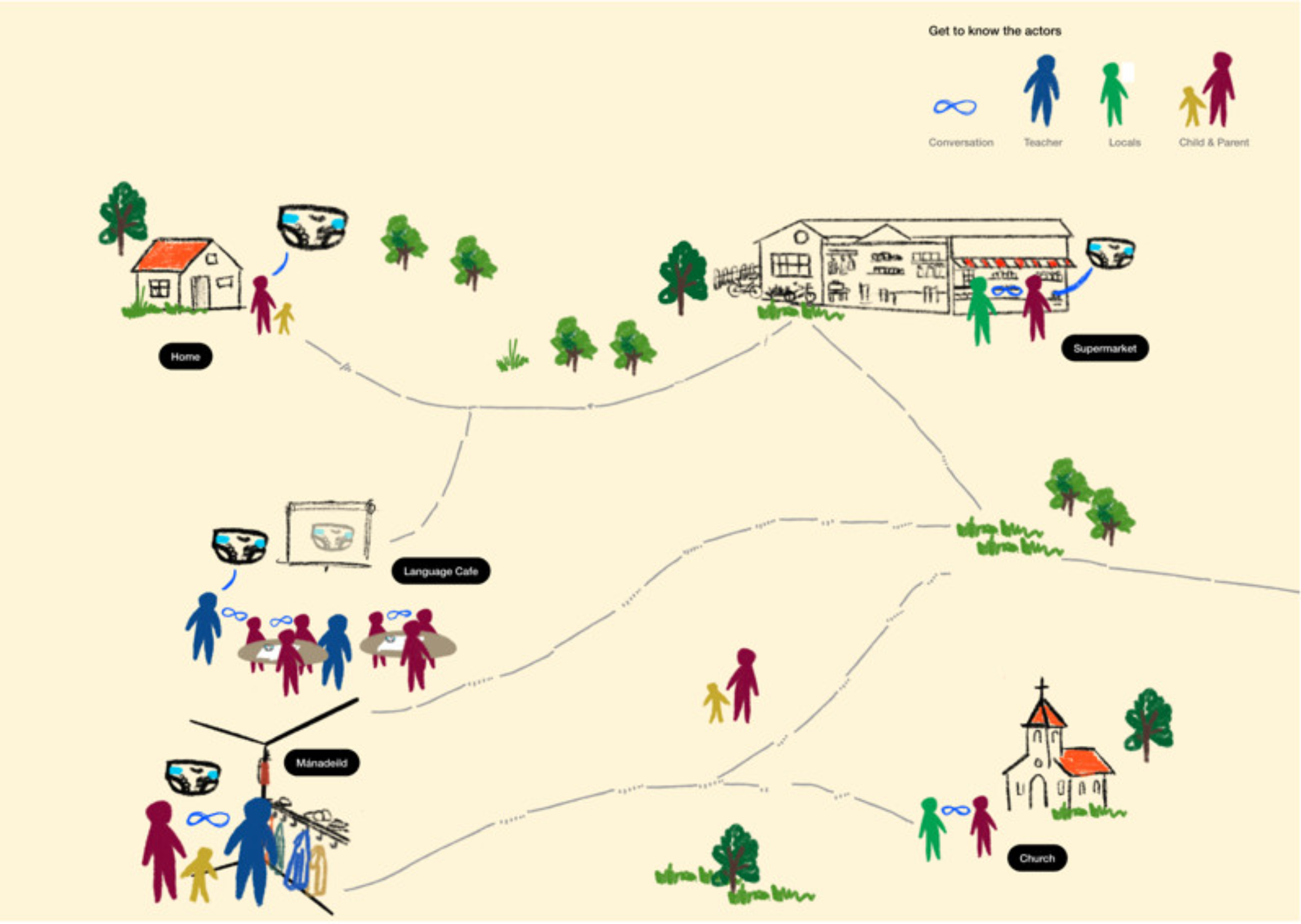
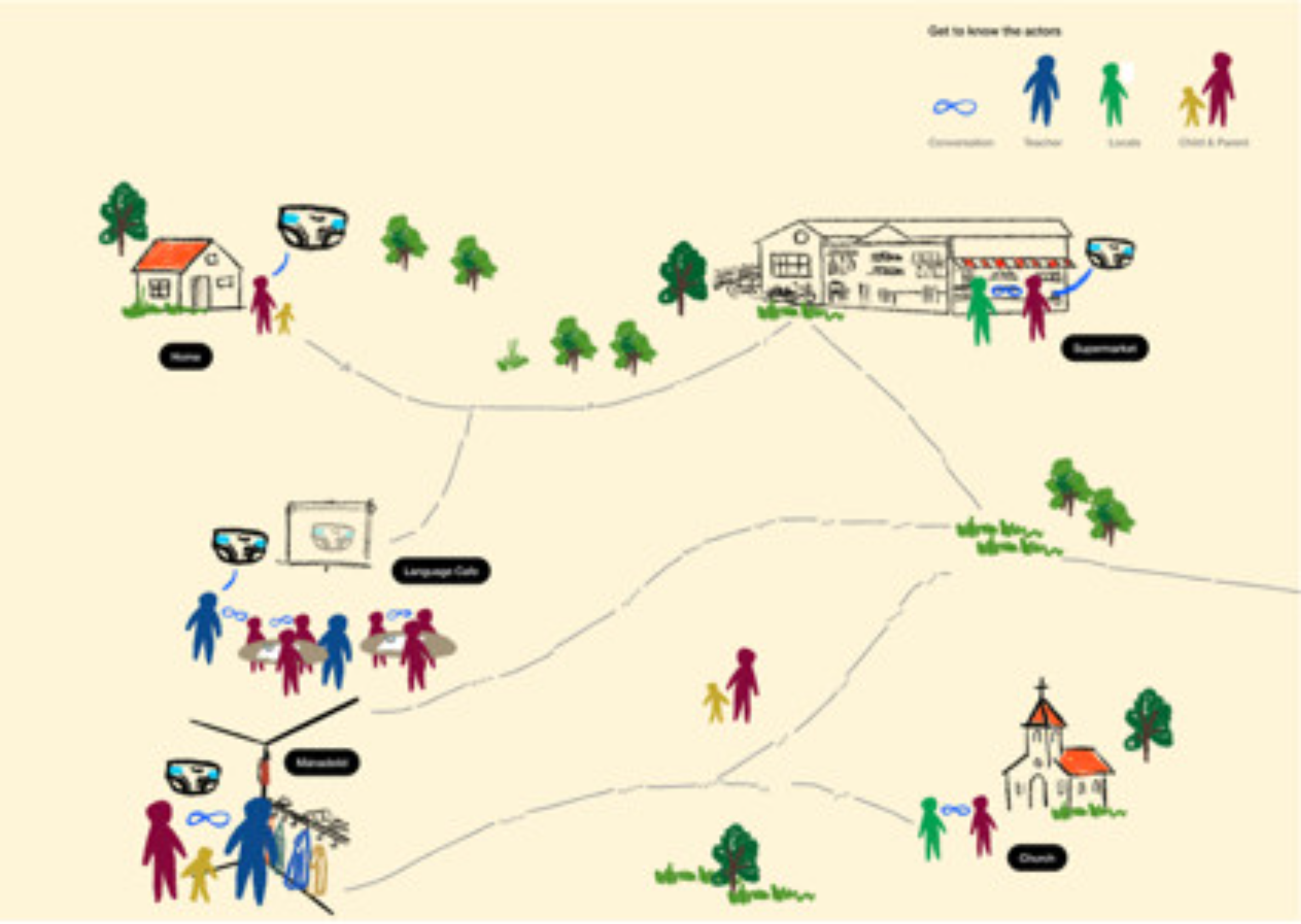
The lab also introduced conceptual resources, such as attention to material artefacts, interactional spaces, and tool sequencing, that informed the design of subsequent workshops. Specifically, creating visual representations of both the Kindergarten spaces and people involved, but also identifying and mapping the flow materials between different spaces. After an initial workshop in which Gulla invited staff to map where they interact with parents and identify the artefacts involved, attention turned to a familiar practice: leaving a note for a parent in the child’s box when more diapers were needed. The note combined simple Icelandic words with an image of a diaper. As an everyday purchased item that circulates across home, shop, and kindergarten, the diaper emerged as a multi-contextual object, a functional ojbect with potential to anchor repeated interaction. It links prior encounters (buying diapers) with ongoing communication between staff and parents. By selecting such an object, the team identified a concrete focal point through which to interactions could be extended and made meaningful over time.

understanding does not come first, it develops through action.
Middle Layer: Collaborative Workshops as Sites of Inquiry: The workshops with kindergarten staff functioned as the central arena for collective sense-making and experimentation, in this case led by the project coordinator and the core teachers. Here, tools from the L2W repertoire were not simply presented, but explored through structured activities:
- Mapping where and how staff interact with parents
- Visualizing the circulation of physical and digital materials
- Trying out sequences of activities that foreground interaction
It is within this layer that the notion of multi-contextual objects emerged. For example, the diaper note, combining simple Icelandic text and imagery, became visible as more than a functional message. As an object that moves between the kindergarten, the home, and the marketplace, it offers a recurring and recognizable anchor for communication. This mirrors patterns seen elsewhere in the Co-Lab, illustrating how shared workshop activity enables participants to recognize latent learning affordances in everyday practices.
The partner workshops such as in Denmark further reinforced this layer as a space for reflection and articulation. Through visualization exercises, the insight that the kindergarten was shifting from a staff child space to a staff–child–parent communicative environment, captures how participation in these activities reshapes how practitioners understand their own setting.
Bottom Layer: Situated Practice and Local Experimentation: The transformation ultimately takes place in the day-to-day practices of the kindergarten, where staff begin to adapt and reconfigure interactions with parents. In this case, the efforts moved toward exploring new formats for engaging parents in a language café arrangement. This includes:
- Reworking existing communication practices (e.g., notes, exchanges at pick-up/drop-off)
- Using familiar objects as anchors for repeated language interaction
- Expanding the role of parents as active participants in communication
Here, tools and concepts introduced in the workshops become meaningful only insofar as they are taken up, modified, and embedded in the local ecology of the kindergarten. Rather than implementing predefined activities, teachers engage in ongoing micro-experiments, testing what works in their specific context. This reflects the bottom layer of the Co-Lab model as a space of appropriation and transformation.
Across Layers: Motivation, Energy, and Agency: What connects the three layers is the emergence of motivation, energy, and agency. The lab does not prescribe solutions, but instead, it creates conditions in which participants:
- discover new possibilities within familiar practices
- develop ownership over emerging ideas
- gain confidence to continue experimenting
This energy is generated through movement across layers: from reframing (top), to shared exploration (middle), to situated action (bottom), and back again. The Icelandic case demonstrates how a public service setting, without being redesigned from scratch, can become an arena for in-the-wild learning through this iterative, distributed process.
Example of project results:
Threshold course - cooperative assessment: The results of the co-design approach to language learning in the wild can be seen in the country-specific examples in Iceland and Belgium. For instance, the in Belgium, the newly developed Threshold course introduced a non-geographical map and moveable tokens as a classroom-based assessment activity. This map and activity is merely one iteration of the teacher’s work, demonstrating uptake of not a single method, but of an approach to language learning in-the-wild.
It is organized around a shared table with the central artifacts poster-sized map, paper tokens, and the use of Post-it notes, and pens. The map is introduced and used by each student through a sequence of activities, where the students are supported in structuring their own experience into the map, with cycles of presenting to others. It culminates in one student presents at a time while peers, teachers, and volunteers gather around the table, with options to ask questions and comments, before moving collectively to the next room for the following presentation.
The lab also introduced conceptual resources, such as attention to material artefacts, interactional spaces, and tool sequencing, that informed the design of subsequent workshops. Specifically, creating visual representations of both the Kindergarten spaces and people involved, but also identifying and mapping the flow materials between different spaces. After an initial workshop in which Gulla invited staff to map where they interact with parents and identify the artefacts involved, attention turned to a familiar practice: leaving a note for a parent in the child’s box when more diapers were needed. The note combined simple Icelandic words with an image of a diaper. As an everyday purchased item that circulates across home, shop, and kindergarten, the diaper emerged as a multi-contextual object, a functional ojbect with potential to anchor repeated interaction. It links prior encounters (buying diapers) with ongoing communication between staff and parents. By selecting such an object, the team identified a concrete focal point through which to interactions could be extended and made meaningful over time.
The lab also introduced conceptual resources, such as attention to material artefacts, interactional spaces, and tool sequencing, that informed the design of subsequent workshops. Specifically, creating visual representations of both the Kindergarten spaces and people involved, but also identifying and mapping the flow materials between different spaces. After an initial workshop in which Gulla invited staff to map where they interact with parents and identify the artefacts involved, attention turned to a familiar practice: leaving a note for a parent in the child’s box when more diapers were needed. The note combined simple Icelandic words with an image of a diaper. As an everyday purchased item that circulates across home, shop, and kindergarten, the diaper emerged as a multi-contextual object, a functional ojbect with potential to anchor repeated interaction. It links prior encounters (buying diapers) with ongoing communication between staff and parents. By selecting such an object, the team identified a concrete focal point through which to interactions could be extended and made meaningful over time.
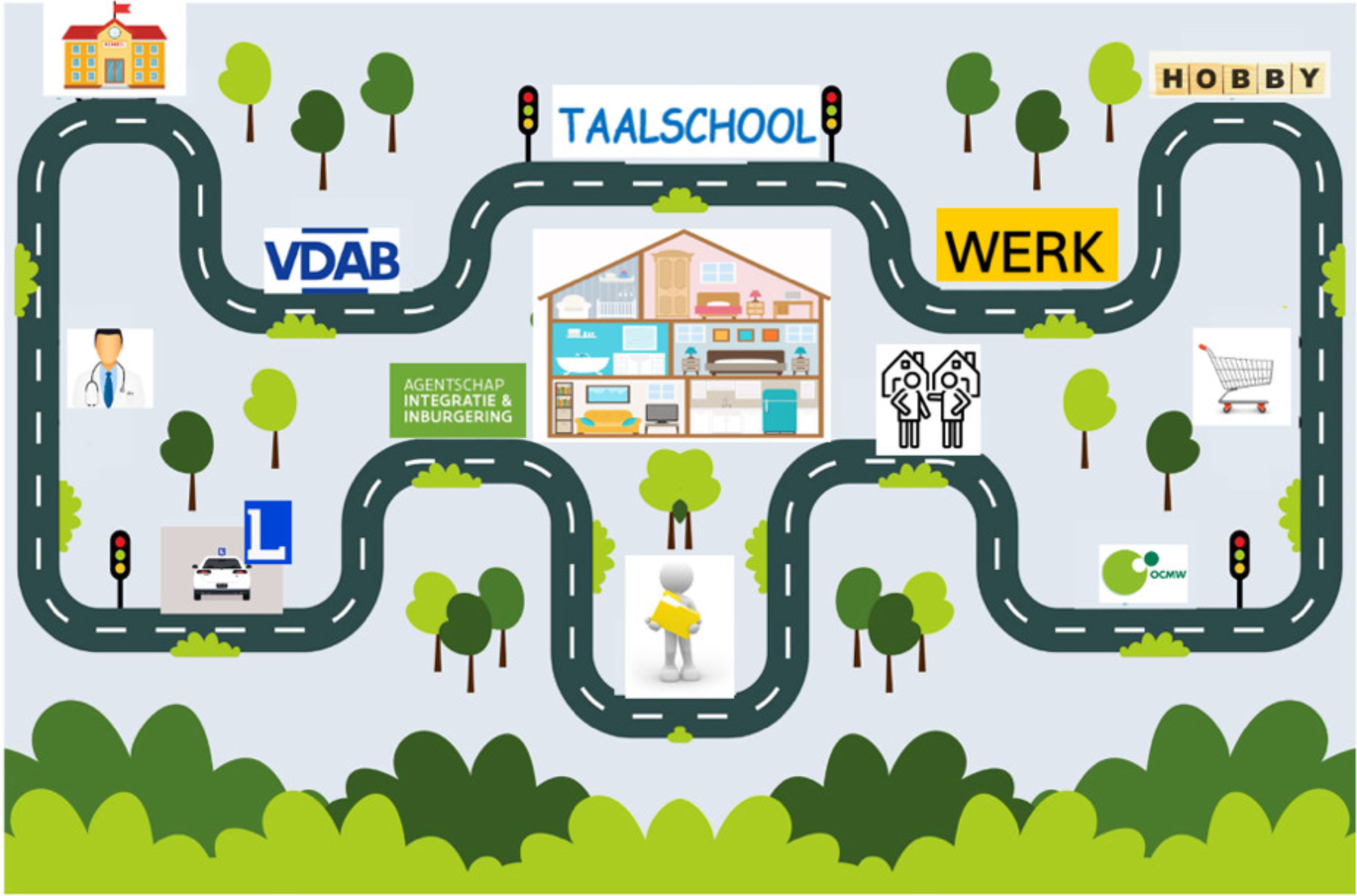
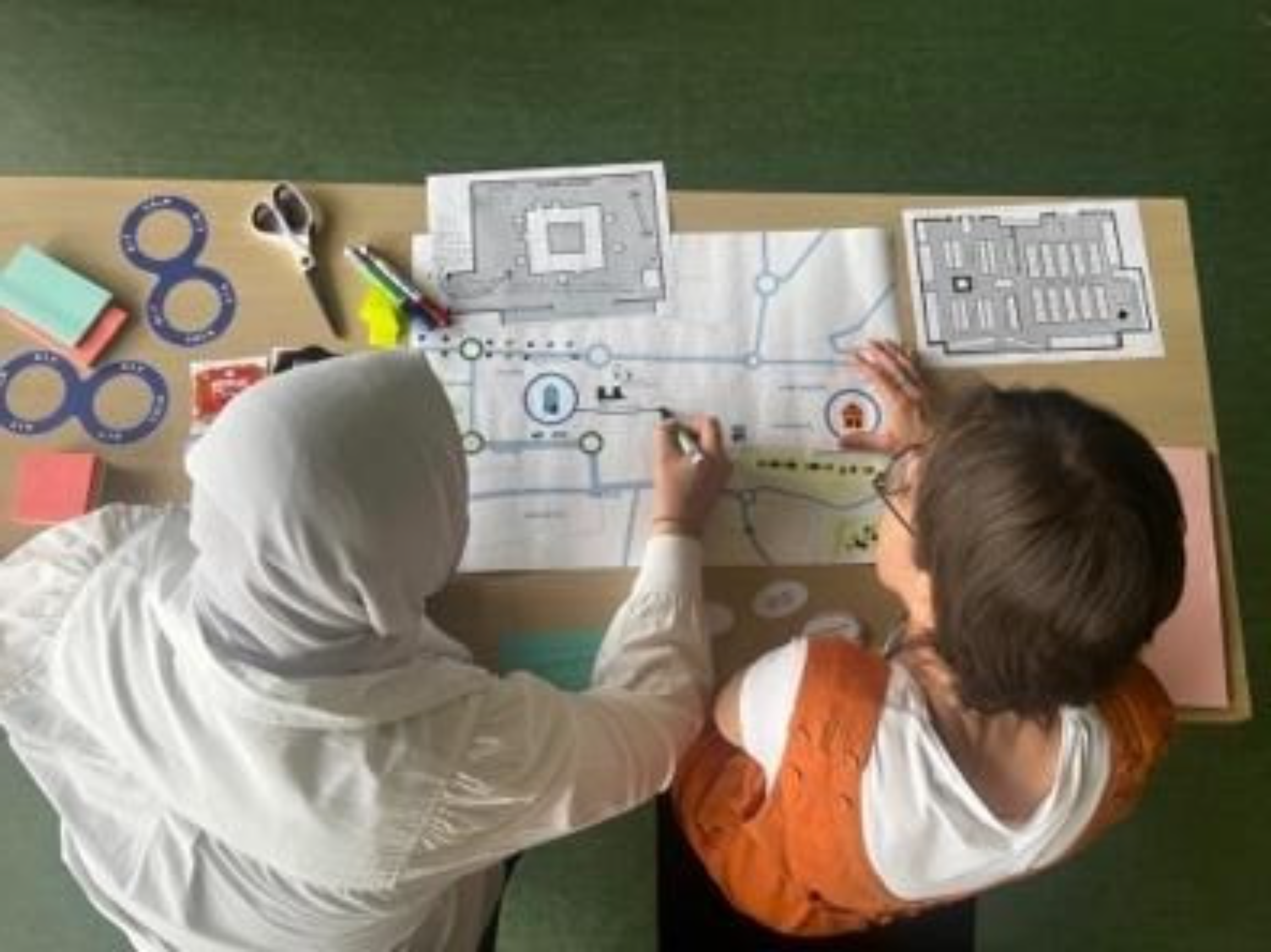
A non-geographical map with domain pictograms.
The map, like a game-board, has a road populated by pictograms representing key domains of everyday life within the local area: children’s schools, language school, work, hobbies, shopping, social services, administration, integration center, driving lessons, healthcare, and vocational training and job application. At the center is a pictogram of a home and neighbors.
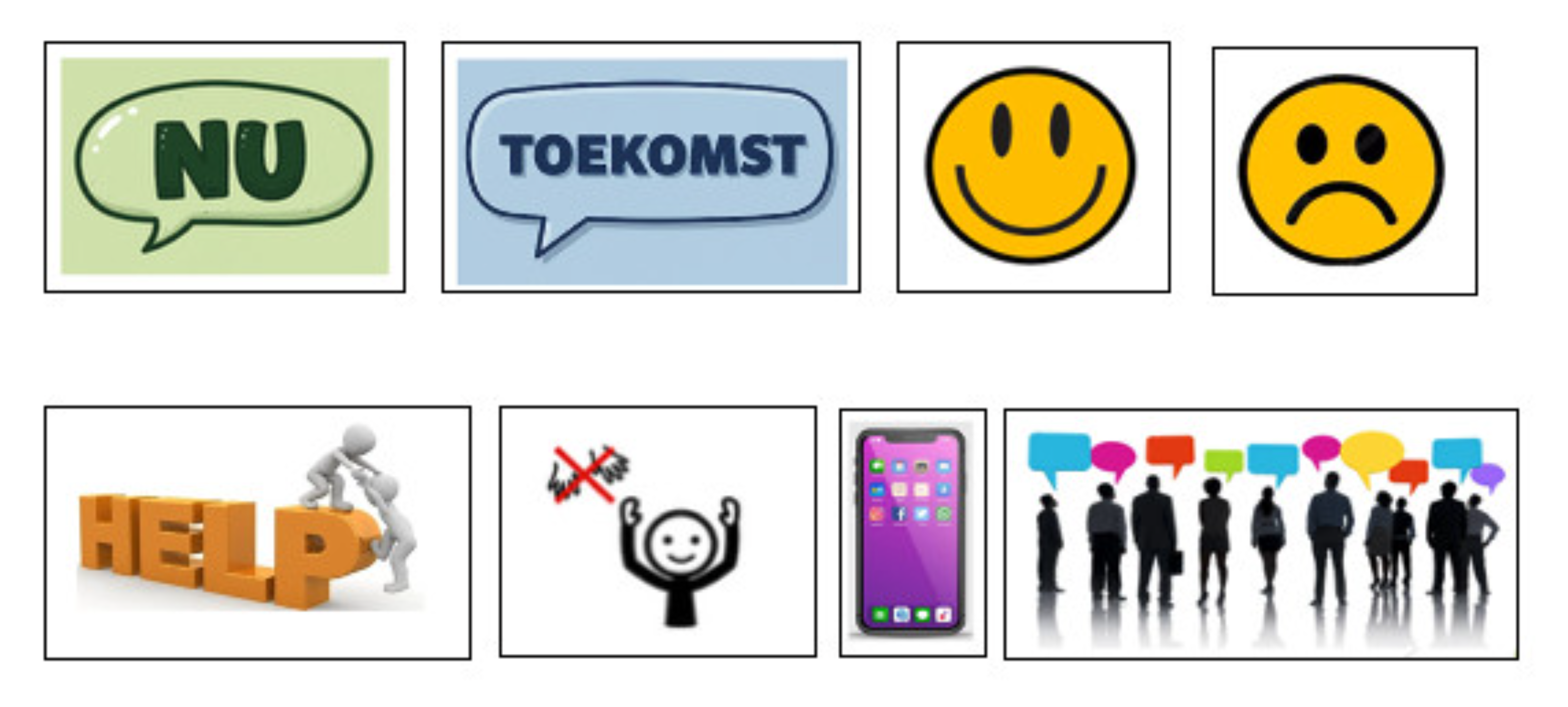
Like game cards, there are Five types of paper “tokens” for placing on chosen locations:
- Temporal markers like ‘nu’ (now) and ‘toekomst’ (future)
- Emotional indicators (smiley, sad face)
- Help indicators (‘help’, ‘no help’)
- A smartphone symbol
- An icon for group, representing family and societal expectations and/or resistances
Hybrid Collaborative Design Lab team, Umeå Institute of Design, Umeå University
- Brendon Clark, associate professor, project lead
- Anjuli Tusha Acharya, Interaction Designer (former student)
- Lin Wang, Interaction designer (former student)
- Regina Gensinger, Digital product designer (former student)
- Akshat Sawarni, UX designer (former student)
🇸🇪
Sweden
Hybrid Collaborative Design Lab
How can educators and learners notice, understand, and learn from the unpredictable and often fleeting moments of language use that occur outside the classroom?
Within the Erasmus+ project Language Learning in the Wild (L2W, 2023–2026), the Hybrid Collaborative Design Lab, led by Brendon Clark at Umeå Institute of Design, brings together researchers, practitioners, teachers, and learners to explore how language learning happens in everyday life, and to support them in developing their own local language learning in-the-wild approach. Building on earlier Scandinavian initiatives, the lab provides tools, formats, shared spaces, and guidance where participants can develop and test approaches suited to their own local contexts, while reflecting together on emerging challenges and opportunities.
Learning “in the wild” shifts the focus away from language as a fixed system of rules and vocabulary, and toward how language is actually used in real-life situations. It emphasizes how people make meaning through interactions with others, objects, and environments in the flow of daily life. This shift brings new challenges: how can educators and learners notice, understand, and learn from the unpredictable and often fleeting moments of language use that occur outside the classroom?
To address this, co-design plays a central role. In L2W, co-design is about making the complexity of real-world language use visible and workable. Through simple physical and visual materials, participants create representations of past and possible future situations “in the wild,” exploring how interactions unfold in practice: where they happen, who is involved, and what tools and environments are part of them. These material explorations support richer discussions and open-up new ways of thinking about language learning how to support learning, reframing it as an active processes of learning-by-doing.
While traditional research offers detailed insights into how people interact and learn, these are often presented in dense academic texts. Co-design complements this by creating practical, accessible platforms for exploring interactions as they unfold, as well as reflecting on them afterward. These temporary structures help participants attend to the relationships between people, objects, and spaces, and to connect past experiences, present situations, and future possibilities, supporting ongoing reflection, learning, and action.
Brendon Clark
Project Manager, Hybrid Collaborative Design Lab
Collaborative Design as a practical approach for supporting Language Learning in the Wild
Read More
→
The Hybrid Co-Design Lab operated through two overlapping streams of activities that supported knowledge sharing and development during ongoing project activities:
- Cross-partner collaboration: Researchers and practitioners from each country met regularly throughout the project, both in annual in-person gatherings across Iceland, Sweden, Denmark, and Belgium, and in regular online meetings. Co-design was used to support making each initiative’s work visible and tangible, supporting shared reflection on challenges, opportunities, and future directions.
- Country-specific collaboration: Each partner led activities connected to their local context and pace of work, often involving additional practitioners, as well as the target learners. Co-design was used upon request to support the building up for development processes, and creating spaces for exploring through cycles of action and reflection. These combined in-person sessions with hybrid formats, allowing participants to work together both onsite together and remotely.
Text about image here
(1) Learn about previous tools and practices of language learning in-the-wild repository of examples and learn about collaborative design practices through hands-on activities.
(2) Adapt, develop and try out tools and practices for implementation in their local context based on the specific people and challenges from each environment.
(3) Implement and further adapt tools and practices to the local context with collaborative support for the challenges that arise.

The lab is built on the experiential learning premise (or hidden curriculum), that learners learn from the structure, relationships, and methods of teaching just as much as from the official curriculum.
Collaborative design operates through cycles of experimentation, reflection, and adaptation. Rather than beginning with theory and moving toward implementation, participants begin by trying small interventions in practice. These interventions generate experiences that can be discussed, analyzed, and adjusted. Over time, repeated cycles of experimentation allow new practices to emerge organically.
The chapter identifies a recurring pattern that underpins this process: participants try something in practice, make it visible and discussable, reflect on what happened, and then adjust their approach accordingly. This iterative process allows change to emerge gradually rather than being imposed from above. As the authors describe, "Rather than moving directly from theory to implementation, change emerges gradually through iterative processes."
A central mechanism within this process is the creation of representations that make experience visible. Maps, sketches, diagrams, role-play activities, physical materials, and visual templates are used to externalize experiences that would otherwise remain invisible. These artifacts create shared reference points that allow participants to discuss their practices and identify opportunities for change. The emphasis is not on producing perfect representations but on creating materials that support collective reflection.
The chapter also draws heavily from traditions of theatre, play, and improvisation. Concepts such as staging and performance are used to design situations in which participants can explore new forms of interaction. Staging involves deliberately arranging conditions that lead toward real encounters, while performance refers to participants acting within unfolding situations using the resources available to them. These activities are not simulations of reality but structured opportunities for engaging with reality itself. As the authors explain, "staging refers to the deliberate design of conditions for action."
Improvisation contributes another important dimension. Through structured games and playful activities, participants develop attentiveness, responsiveness, and collaborative sense-making. Play is not viewed as entertainment but as a serious form of inquiry that enables experimentation within safe boundaries. The chapter concludes that collaborative design, play, and improvisation work together as "complementary ways of working" that emphasize participation, exploration, and the emergence of new practices through lived experience.
Perhaps most importantly, collaborative design seeks to support transitions rather than implementations. It creates temporary arrangements where people can test new ways of organizing participation before committing to more permanent changes. As the authors explain, "Co-Design therefore seeks to support transitions by making change tangible, visible and manageable."
Supporting technologies and demonstrator
The Dare-to-Talk app is an example of a concept and a now outdated smart phone app, that can now be replaced by readily available technology. At the same time, the concept relies upon new forms of organizing experiential learning activities to become valuable.
The Dare-to-Talk app is an example of a concept and a now outdated smart phone app, that can now be replaced by readily available technology. At the same time, the concept relies upon new forms of organizing experiential learning activities to become valuable.
Examples of the Hybrid Collaborative Design Lab activities:
Repository of tools & inspiration:
The lab draws on a repertoire of research and practice developed in the language learning in the wild network partners such as the Språkskap vision and Sit-talk-Sit experiential learning model, The Icelandic Village as a network of local business where students can try out their Icelandic combined with analyzing those interactions in the classroom, and Finnish in the Wild supporting the co-design of out-side-the-classroom learning tasks. Select tools and inspiration from this repertoire are introduced through workshop activities, sequenced to support a learning-by-doing approach for educators, as basis of developing their own approach. For instance, the publication Co-creating language learning journeys: A designerly approach to supporting experiential language learning practices (Clark & Torretta 2018) introduces a selection of tools that have been developed through these previous initiatives.
The lab draws on a repertoire of research and practice developed in the language learning in the wild network partners such as the Språkskap vision and Sit-talk-Sit experiential learning model, The Icelandic Village as a network of local business where students can try out their Icelandic combined with analyzing those interactions in the classroom, and Finnish in the Wild supporting the co-design of out-side-the-classroom learning tasks. Select tools and inspiration from this repertoire are introduced through workshop activities, sequenced to support a learning-by-doing approach for educators, as basis of developing their own approach. For instance, the publication Co-creating language learning journeys: A designerly approach to supporting experiential language learning practices (Clark & Torretta 2018) introduces a selection of tools that have been developed through these previous initiatives.
- Mapping daily interactions (Journey Mapping, Photo Diary)
- Identifying opportunities (Scouting, My Places, Network Map)
- Structuring interactions (Sit-talk-Sit, Interaction Navigator)
- Expanding conversations (Expander)
- Documenting and reflecting (One-shot video)
These tools have been developed and used to support learners turn everyday experiences into objects of reflection and learning, yet they often do not work alone, nor do they fit nicely into language teaching activities. Instead, they are introduced to educators through workshop activities that emphasize the need to try-out and reflect upon their value, and how they may become valuable within a sequence of activities. Each effort to introduce these tools, triggers the development of new tools to further support the issues that arise.
Taalarena Co-lab
Another recurring example is the Sit–Talk–Sit structure. Developed as a simple scaffold for participation, it organizes learning into three stages: preparation, interaction, and reflection. Learners prepare for an encounter, engage in a real interaction, and then pause to review what occurred. The value of the model lies in its simplicity and adaptability across contexts. As the authors note, it provides "a manageable rhythm that can be repeated across situations without prescribing exactly what should happen."
Another recurring example is the Sit–Talk–Sit structure. Developed as a simple scaffold for participation, it organizes learning into three stages: preparation, interaction, and reflection. Learners prepare for an encounter, engage in a real interaction, and then pause to review what occurred. The value of the model lies in its simplicity and adaptability across contexts. As the authors note, it provides "a manageable rhythm that can be repeated across situations without prescribing exactly what should happen."

- Top layer (Lab team activities): design, facilitation, and support work conducted by the lab and co-design team.
- Middle layer (Collaborative activities): workshops and shared experiments involving both teachers and the lab team.
- Bottom layer (Teacher activities): situated practices carried out by teachers within their own educational contexts.
Another recurring example is the Sit–Talk–Sit structure. Developed as a simple scaffold for participation, it organizes learning into three stages: preparation, interaction, and reflection. Learners prepare for an encounter, engage in a real interaction, and then pause to review what occurred. The value of the model lies in its simplicity and adaptability across contexts. As the authors note, it provides "a manageable rhythm that can be repeated across situations without prescribing exactly what should happen."
Staging a mock German Library for Dutch teachers (the classroom as rehearsal space)
After initial exposure to tools and inspiration about L2W, we sought to create an experience that could bring more appreciation to both the challenges that learners face “in-the-wild”, but also to appreciate the use of objects and scaffolding to support those challenges. The local coordinator, with remote support from the co-lab team, staged and facilitated a workshop where the Dutch teachers would try out a sit-talk-sit sequence in relation to a mock-German library. The coordinator brought about 20 German books, asked the most fluent German speaking teacher to play the role of the librarian, and staged a sequence of the “learner” finding an object (in this case a book), developing questions in German and warming-up with two others as support, then standing-up, walking to the librarian design and talking with her, and returning the other two to reflect on how it went. Upon reflection on the workshop activity, some teachers reported that it was only then that they understood the approach.
A defining feature of the Co-Lab model is the oscillation between collective experimentation and situated enactment. The co-design role moves between facilitating shared workshops and supporting localized adaptations, while also enabling rapid production of both physical and digital materials that mediate this process. In doing so, the lab creates conditions for teachers not only to experience tools such as Sit-talk-Sit or Journey Mapping, but to test, combine, and reconfigure them into meaningful sequences of activities.
Extending the Icelandic Village – Transforming a public service into an arena for in-the-wild learning

The Icelandic case can be understood as a concrete instantiation of the Co-Lab model, where activities unfold across three interrelated layers: lab facilitation (top), collaborative workshops (middle), and situated teacher practice (bottom). This structuring helps clarify how transformation emerges not from a single intervention, but through the interaction between design support, shared experimentation, and local enactment.
Top Layer: Co-Lab Facilitation and Design Support: At the level of the lab, the Co-Lab provided the Icelandic coordinator (Gulla) with a reflective and strategic design space. Through Zoom meetings and in-person encounters, the focus was on reframing challenges, selecting and adapting tools from the shared repertoire, and sequencing activities. A key intervention at this level was the reframing of the project from a general ambition of “language learning” to the more grounded and actionable goal of improving communication between kindergarten staff and parents. This shift illustrates how the lab layer supports alignment between the broader L2W agenda and the institutional realities of practice.
The lab also introduced conceptual resources, such as attention to material artefacts, interactional spaces, and tool sequencing, that informed the design of subsequent workshops. Specifically, creating visual representations of both the Kindergarten spaces and people involved, but also identifying and mapping the flow materials between different spaces. After an initial workshop in which Gulla invited staff to map where they interact with parents and identify the artefacts involved, attention turned to a familiar practice: leaving a note for a parent in the child’s box when more diapers were needed. The note combined simple Icelandic words with an image of a diaper. As an everyday purchased item that circulates across home, shop, and kindergarten, the diaper emerged as a multi-contextual object, a functional ojbect with potential to anchor repeated interaction. It links prior encounters (buying diapers) with ongoing communication between staff and parents. By selecting such an object, the team identified a concrete focal point through which to interactions could be extended and made meaningful over time.
Middle Layer: Collaborative Workshops as Sites of Inquiry: The workshops with kindergarten staff functioned as the central arena for collective sense-making and experimentation, in this case led by the project coordinator and the core teachers. Here, tools from the L2W repertoire were not simply presented, but explored through structured activities:
- Mapping where and how staff interact with parents
- Visualizing the circulation of physical and digital materials
- Trying out sequences of activities that foreground interaction
It is within this layer that the notion of multi-contextual objects emerged. For example, the diaper note, combining simple Icelandic text and imagery, became visible as more than a functional message. As an object that moves between the kindergarten, the home, and the marketplace, it offers a recurring and recognizable anchor for communication. This mirrors patterns seen elsewhere in the Co-Lab, illustrating how shared workshop activity enables participants to recognize latent learning affordances in everyday practices.
The partner workshops such as in Denmark further reinforced this layer as a space for reflection and articulation. Through visualization exercises, the insight that the kindergarten was shifting from a staff child space to a staff–child–parent communicative environment, captures how participation in these activities reshapes how practitioners understand their own setting.
Bottom Layer: Situated Practice and Local Experimentation: The transformation ultimately takes place in the day-to-day practices of the kindergarten, where staff begin to adapt and reconfigure interactions with parents. In this case, the efforts moved toward exploring new formats for engaging parents in a language café arrangement. This includes:
- Reworking existing communication practices (e.g., notes, exchanges at pick-up/drop-off)
- Using familiar objects as anchors for repeated language interaction
- Expanding the role of parents as active participants in communication
Here, tools and concepts introduced in the workshops become meaningful only insofar as they are taken up, modified, and embedded in the local ecology of the kindergarten. Rather than implementing predefined activities, teachers engage in ongoing micro-experiments, testing what works in their specific context. This reflects the bottom layer of the Co-Lab model as a space of appropriation and transformation.
Across Layers: Motivation, Energy, and Agency: What connects the three layers is the emergence of motivation, energy, and agency. The lab does not prescribe solutions, but instead, it creates conditions in which participants:
- discover new possibilities within familiar practices
- develop ownership over emerging ideas
- gain confidence to continue experimenting
This energy is generated through movement across layers: from reframing (top), to shared exploration (middle), to situated action (bottom), and back again. The Icelandic case demonstrates how a public service setting, without being redesigned from scratch, can become an arena for in-the-wild learning through this iterative, distributed process.
Example of project results:
Threshold course - cooperative assessment: The results of the co-design approach to language learning in the wild can be seen in the country-specific examples in Iceland and Belgium. For instance, the in Belgium, the newly developed Threshold course introduced a non-geographical map and moveable tokens as a classroom-based assessment activity. This map and activity is merely one iteration of the teacher’s work, demonstrating uptake of not a single method, but of an approach to language learning in-the-wild.
It is organized around a shared table with the central artifacts poster-sized map, paper tokens, and the use of Post-it notes, and pens. The map is introduced and used by each student through a sequence of activities, where the students are supported in structuring their own experience into the map, with cycles of presenting to others. It culminates in one student presents at a time while peers, teachers, and volunteers gather around the table, with options to ask questions and comments, before moving collectively to the next room for the following presentation.
The lab also introduced conceptual resources, such as attention to material artefacts, interactional spaces, and tool sequencing, that informed the design of subsequent workshops. Specifically, creating visual representations of both the Kindergarten spaces and people involved, but also identifying and mapping the flow materials between different spaces. After an initial workshop in which Gulla invited staff to map where they interact with parents and identify the artefacts involved, attention turned to a familiar practice: leaving a note for a parent in the child’s box when more diapers were needed. The note combined simple Icelandic words with an image of a diaper. As an everyday purchased item that circulates across home, shop, and kindergarten, the diaper emerged as a multi-contextual object, a functional ojbect with potential to anchor repeated interaction. It links prior encounters (buying diapers) with ongoing communication between staff and parents. By selecting such an object, the team identified a concrete focal point through which to interactions could be extended and made meaningful over time.
A non-geographical map with domain pictograms.
The map, like a game-board, has a road populated by pictograms representing key domains of everyday life within the local area: children’s schools, language school, work, hobbies, shopping, social services, administration, integration center, driving lessons, healthcare, and vocational training and job application. At the center is a pictogram of a home and neighbors.
Like game cards, there are Five types of paper “tokens” for placing on chosen locations:
- Temporal markers like ‘nu’ (now) and ‘toekomst’ (future)
- Emotional indicators (smiley, sad face)
- Help indicators (‘help’, ‘no help’)
- A smartphone symbol
- An icon for group, representing family and societal expectations and/or resistances
Hybrid Collaborative Design Lab team, Umeå Institute of Design, Umeå University
- Brendon Clark, associate professor, project lead
- Anjuli Tusha Acharya, Interaction Designer (former student)
- Lin Wang, Interaction designer (former student)
- Regina Gensinger, Digital product designer (former student)
- Akshat Sawarni, UX designer (former student)
🇸🇪
Sweden
Hybrid Collaborative Design Lab
How can educators and learners notice, understand, and learn from the unpredictable and often fleeting moments of language use that occur outside the classroom?
Within the Erasmus+ project Language Learning in the Wild (L2W, 2023–2026), the Hybrid Collaborative Design Lab, led by Brendon Clark at Umeå Institute of Design, brings together researchers, practitioners, teachers, and learners to explore how language learning happens in everyday life, and to support them in developing their own local language learning in-the-wild approach. Building on earlier Scandinavian initiatives, the lab provides tools, formats, shared spaces, and guidance where participants can develop and test approaches suited to their own local contexts, while reflecting together on emerging challenges and opportunities.
Learning “in the wild” shifts the focus away from language as a fixed system of rules and vocabulary, and toward how language is actually used in real-life situations. It emphasizes how people make meaning through interactions with others, objects, and environments in the flow of daily life. This shift brings new challenges: how can educators and learners notice, understand, and learn from the unpredictable and often fleeting moments of language use that occur outside the classroom?
To address this, co-design plays a central role. In L2W, co-design is about making the complexity of real-world language use visible and workable. Through simple physical and visual materials, participants create representations of past and possible future situations “in the wild,” exploring how interactions unfold in practice: where they happen, who is involved, and what tools and environments are part of them. These material explorations support richer discussions and open-up new ways of thinking about language learning how to support learning, reframing it as an active processes of learning-by-doing.
While traditional research offers detailed insights into how people interact and learn, these are often presented in dense academic texts. Co-design complements this by creating practical, accessible platforms for exploring interactions as they unfold, as well as reflecting on them afterward. These temporary structures help participants attend to the relationships between people, objects, and spaces, and to connect past experiences, present situations, and future possibilities, supporting ongoing reflection, learning, and action.
Brendon Clark
Project Manager, Hybrid Collaborative Design Lab
Collaborative Design as a practical approach for supporting Language Learning in the Wild
Read More
→
The Hybrid Co-Design Lab operated through two overlapping streams of activities that supported knowledge sharing and development during ongoing project activities:
- Cross-partner collaboration: Researchers and practitioners from each country met regularly throughout the project, both in annual in-person gatherings across Iceland, Sweden, Denmark, and Belgium, and in regular online meetings. Co-design was used to support making each initiative’s work visible and tangible, supporting shared reflection on challenges, opportunities, and future directions.
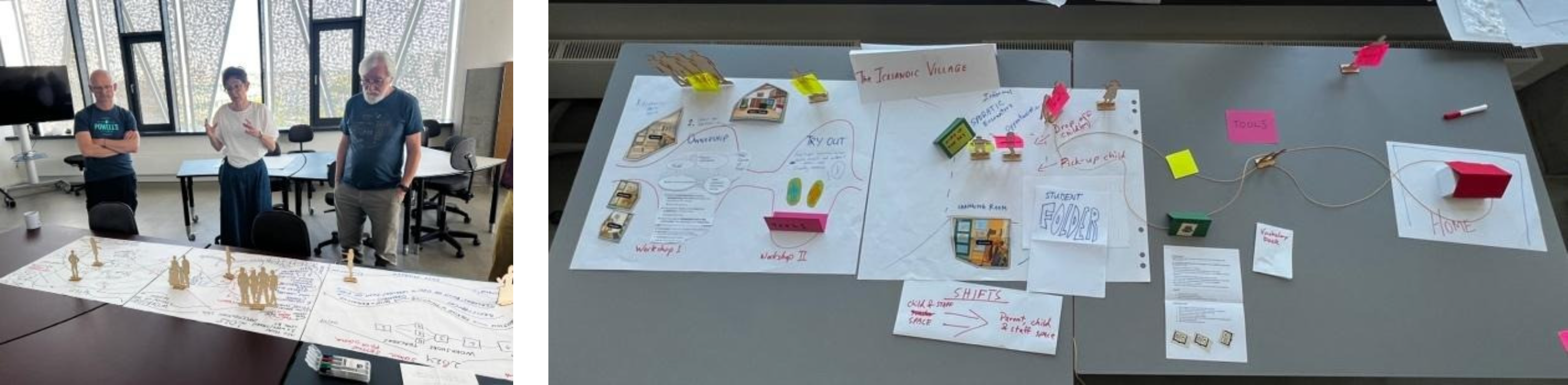
- Country-specific collaboration: Each partner led activities connected to their local context and pace of work, often involving additional practitioners, as well as the target learners. Co-design was used upon request to support the building up for development processes, and creating spaces for exploring through cycles of action and reflection. These combined in-person sessions with hybrid formats, allowing participants to work together both onsite together and remotely.
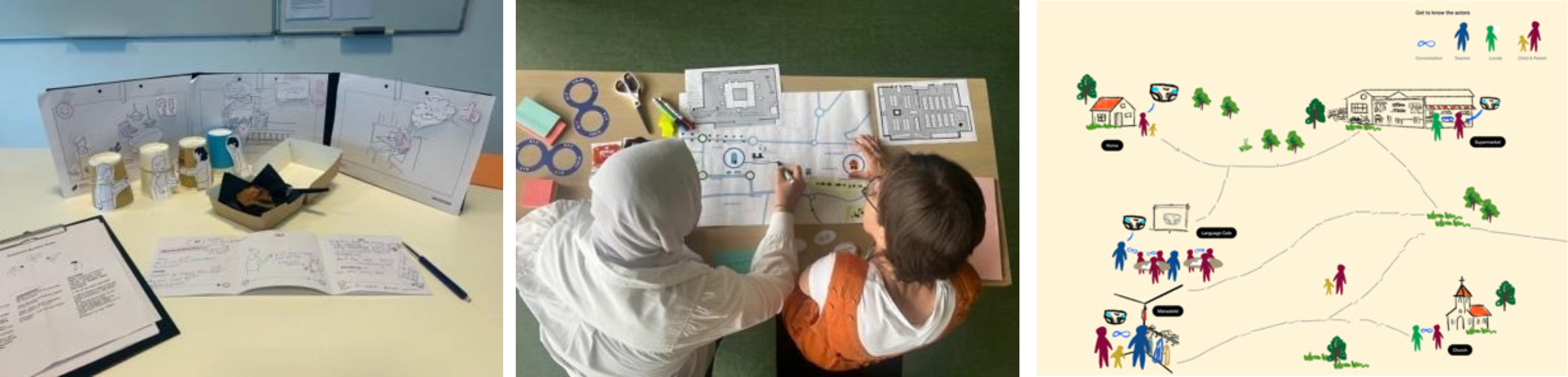
(1) Learn about previous tools and practices of language learning in-the-wild repository of examples and learn about collaborative design practices through hands-on activities.
(2) Adapt, develop and try out tools and practices for implementation in their local context based on the specific people and challenges from each environment.
(3) Implement and further adapt tools and practices to the local context with collaborative support for the challenges that arise.

The lab is built on the experiential learning premise (or hidden curriculum), that learners learn from the structure, relationships, and methods of teaching just as much as from the official curriculum.
Additionally, rather than merely providing co-design expertise, the goal was for all participants to further develop their own co-design practices, as a basis for introducing L2W to others. Central to co-design facilitation is the practice “staging” group activities, the use of space, materials, and sequences of activities to support a processes of working with materials in action, presenting to others, and adjusting. Note: The lab is built on the experiential learning premise (or hidden curriculum), that learners learn from the structure, relationships, and methods of teaching just as much as from the official curriculum.
A co-design approach to transitions to L2W aims to:
- Explore ways to support social and material interaction in everyday situations
- Make visible the social, emotional, and material dynamics of everyday activities
- Encourage cycles of action and reflection as part of experiential learning
- Surface participants’ circumstances and strengthen relationships through reframing, visualization, and shared descriptions of experience
- Co-create lightweight, temporary structures that support engagement and learning in practice
- Model possibilities through live demonstrations using both self and others
- Share and circulate examples of discovery and learning
Supporting technologies and demonstrator
The Dare-to-Talk app is an example of a concept and a now outdated smart phone app, that can now be replaced by readily available technology. At the same time, the concept relies upon new forms of organizing experiential learning activities to become valuable.
The Dare-to-Talk app is an example of a concept and a now outdated smart phone app, that can now be replaced by readily available technology. At the same time, the concept relies upon new forms of organizing experiential learning activities to become valuable.
Examples of the Hybrid Collaborative Design Lab activities:
Repository of tools & inspiration:
The lab draws on a repertoire of research and practice developed in the language learning in the wild network partners such as the Språkskap vision and Sit-talk-Sit experiential learning model, The Icelandic Village as a network of local business where students can try out their Icelandic combined with analyzing those interactions in the classroom, and Finnish in the Wild supporting the co-design of out-side-the-classroom learning tasks. Select tools and inspiration from this repertoire are introduced through workshop activities, sequenced to support a learning-by-doing approach for educators, as basis of developing their own approach. For instance, the publication Co-creating language learning journeys: A designerly approach to supporting experiential language learning practices (Clark & Torretta 2018) introduces a selection of tools that have been developed through these previous initiatives.
- Mapping daily interactions (Journey Mapping, Photo Diary)
- Identifying opportunities (Scouting, My Places, Network Map)
- Structuring interactions (Sit-talk-Sit, Interaction Navigator)
- Expanding conversations (Expander)
- Documenting and reflecting (One-shot video)
These tools have been developed and used to support learners turn everyday experiences into objects of reflection and learning, yet they often do not work alone, nor do they fit nicely into language teaching activities. Instead, they are introduced to educators through workshop activities that emphasize the need to try-out and reflect upon their value, and how they may become valuable within a sequence of activities. Each effort to introduce these tools, triggers the development of new tools to further support the issues that arise.
Taalarena Co-lab
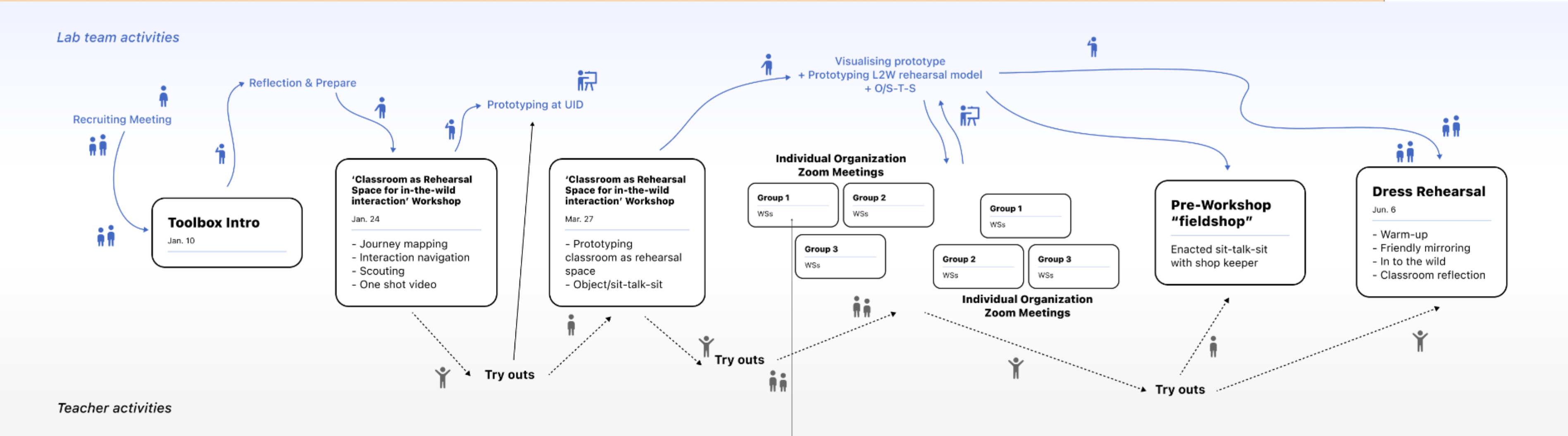
Taalarena Co-lab – A visual description of the Lab activities and Teacher activities during a 6-month introduction period, Lab team activities at the top, teacher activities at the bottom, and collaborative activities in the middle.
The Taalarena Co-Lab offers a visual and temporal description of how lab activities, teacher practices, and collaborative engagements unfold over a six-month introductory period. The visual model distinguishes between three interrelated layers:

- Top layer (Lab team activities): design, facilitation, and support work conducted by the lab and co-design team.
- Middle layer (Collaborative activities): workshops and shared experiments involving both teachers and the lab team.
- Bottom layer (Teacher activities): situated practices carried out by teachers within their own educational contexts.
The Taalarena Co-Lab exemplifies how a co-design function can scaffold the gradual development of both understanding and capability among educators, working with the challenges that arise and adapting activities to address them over time. In this case, the process supported a local coordinator in planning, facilitating, and iterating a series of activities across both in-person and hybrid formats. Over an initial six-month period, a core group of 16 teachers from three adult education organizations engaged in a sequence of interconnected activities: initial recruitment and framing, exploratory workshops introducing the toolbox, staged learning-by-doing sessions, and a final “dress rehearsal” workshop to consolidate, reinforce and test in-the-wild activities.
Rather than operating as isolated events, these activities were deliberately sequenced to support progressive appropriation of tools and approaches. Smaller group sessions within individual organizations complemented the larger workshops, enabling teachers to adapt and situate concepts within their own teaching environments. Following this initial phase, more targeted collaborations with smaller teams allowed for deeper development based on the specific trajectories and needs identified through ongoing dialogue.
Staging a mock German Library for Dutch teachers (the classroom as rehearsal space)
After initial exposure to tools and inspiration about L2W, we sought to create an experience that could bring more appreciation to both the challenges that learners face “in-the-wild”, but also to appreciate the use of objects and scaffolding to support those challenges. The local coordinator, with remote support from the co-lab team, staged and facilitated a workshop where the Dutch teachers would try out a sit-talk-sit sequence in relation to a mock-German library. The coordinator brought about 20 German books, asked the most fluent German speaking teacher to play the role of the librarian, and staged a sequence of the “learner” finding an object (in this case a book), developing questions in German and warming-up with two others as support, then standing-up, walking to the librarian design and talking with her, and returning the other two to reflect on how it went. Upon reflection on the workshop activity, some teachers reported that it was only then that they understood the approach.
A defining feature of the Co-Lab model is the oscillation between collective experimentation and situated enactment. The co-design role moves between facilitating shared workshops and supporting localized adaptations, while also enabling rapid production of both physical and digital materials that mediate this process. In doing so, the lab creates conditions for teachers not only to experience tools such as Sit-talk-Sit or Journey Mapping, but to test, combine, and reconfigure them into meaningful sequences of activities.
Extending the Icelandic Village – Transforming a public service into an arena for in-the-wild learning

The Icelandic case can be understood as a concrete instantiation of the Co-Lab model, where activities unfold across three interrelated layers: lab facilitation (top), collaborative workshops (middle), and situated teacher practice (bottom). This structuring helps clarify how transformation emerges not from a single intervention, but through the interaction between design support, shared experimentation, and local enactment.
Top Layer: Co-Lab Facilitation and Design Support: At the level of the lab, the Co-Lab provided the Icelandic coordinator (Gulla) with a reflective and strategic design space. Through Zoom meetings and in-person encounters, the focus was on reframing challenges, selecting and adapting tools from the shared repertoire, and sequencing activities. A key intervention at this level was the reframing of the project from a general ambition of “language learning” to the more grounded and actionable goal of improving communication between kindergarten staff and parents. This shift illustrates how the lab layer supports alignment between the broader L2W agenda and the institutional realities of practice.
The lab also introduced conceptual resources, such as attention to material artefacts, interactional spaces, and tool sequencing, that informed the design of subsequent workshops. Specifically, creating visual representations of both the Kindergarten spaces and people involved, but also identifying and mapping the flow materials between different spaces. After an initial workshop in which Gulla invited staff to map where they interact with parents and identify the artefacts involved, attention turned to a familiar practice: leaving a note for a parent in the child’s box when more diapers were needed. The note combined simple Icelandic words with an image of a diaper. As an everyday purchased item that circulates across home, shop, and kindergarten, the diaper emerged as a multi-contextual object, a functional ojbect with potential to anchor repeated interaction. It links prior encounters (buying diapers) with ongoing communication between staff and parents. By selecting such an object, the team identified a concrete focal point through which to interactions could be extended and made meaningful over time.
Middle Layer: Collaborative Workshops as Sites of Inquiry: The workshops with kindergarten staff functioned as the central arena for collective sense-making and experimentation, in this case led by the project coordinator and the core teachers. Here, tools from the L2W repertoire were not simply presented, but explored through structured activities:
- Mapping where and how staff interact with parents
- Visualizing the circulation of physical and digital materials
- Trying out sequences of activities that foreground interaction
It is within this layer that the notion of multi-contextual objects emerged. For example, the diaper note, combining simple Icelandic text and imagery, became visible as more than a functional message. As an object that moves between the kindergarten, the home, and the marketplace, it offers a recurring and recognizable anchor for communication. This mirrors patterns seen elsewhere in the Co-Lab, illustrating how shared workshop activity enables participants to recognize latent learning affordances in everyday practices.
The partner workshops such as in Denmark further reinforced this layer as a space for reflection and articulation. Through visualization exercises, the insight that the kindergarten was shifting from a staff child space to a staff–child–parent communicative environment, captures how participation in these activities reshapes how practitioners understand their own setting.
Bottom Layer: Situated Practice and Local Experimentation: The transformation ultimately takes place in the day-to-day practices of the kindergarten, where staff begin to adapt and reconfigure interactions with parents. In this case, the efforts moved toward exploring new formats for engaging parents in a language café arrangement. This includes:
- Reworking existing communication practices (e.g., notes, exchanges at pick-up/drop-off)
- Using familiar objects as anchors for repeated language interaction
- Expanding the role of parents as active participants in communication
Here, tools and concepts introduced in the workshops become meaningful only insofar as they are taken up, modified, and embedded in the local ecology of the kindergarten. Rather than implementing predefined activities, teachers engage in ongoing micro-experiments, testing what works in their specific context. This reflects the bottom layer of the Co-Lab model as a space of appropriation and transformation.
Across Layers: Motivation, Energy, and Agency: What connects the three layers is the emergence of motivation, energy, and agency. The lab does not prescribe solutions, but instead, it creates conditions in which participants:
- discover new possibilities within familiar practices
- develop ownership over emerging ideas
- gain confidence to continue experimenting
This energy is generated through movement across layers: from reframing (top), to shared exploration (middle), to situated action (bottom), and back again. The Icelandic case demonstrates how a public service setting, without being redesigned from scratch, can become an arena for in-the-wild learning through this iterative, distributed process.
Example of project results:
Threshold course - cooperative assessment: The results of the co-design approach to language learning in the wild can be seen in the country-specific examples in Iceland and Belgium. For instance, the in Belgium, the newly developed Threshold course introduced a non-geographical map and moveable tokens as a classroom-based assessment activity. This map and activity is merely one iteration of the teacher’s work, demonstrating uptake of not a single method, but of an approach to language learning in-the-wild.
It is organized around a shared table with the central artifacts poster-sized map, paper tokens, and the use of Post-it notes, and pens. The map is introduced and used by each student through a sequence of activities, where the students are supported in structuring their own experience into the map, with cycles of presenting to others. It culminates in one student presents at a time while peers, teachers, and volunteers gather around the table, with options to ask questions and comments, before moving collectively to the next room for the following presentation.
The lab also introduced conceptual resources, such as attention to material artefacts, interactional spaces, and tool sequencing, that informed the design of subsequent workshops. Specifically, creating visual representations of both the Kindergarten spaces and people involved, but also identifying and mapping the flow materials between different spaces. After an initial workshop in which Gulla invited staff to map where they interact with parents and identify the artefacts involved, attention turned to a familiar practice: leaving a note for a parent in the child’s box when more diapers were needed. The note combined simple Icelandic words with an image of a diaper. As an everyday purchased item that circulates across home, shop, and kindergarten, the diaper emerged as a multi-contextual object, a functional ojbect with potential to anchor repeated interaction. It links prior encounters (buying diapers) with ongoing communication between staff and parents. By selecting such an object, the team identified a concrete focal point through which to interactions could be extended and made meaningful over time.
A non-geographical map with domain pictograms.
The map, like a game-board, has a road populated by pictograms representing key domains of everyday life within the local area: children’s schools, language school, work, hobbies, shopping, social services, administration, integration center, driving lessons, healthcare, and vocational training and job application. At the center is a pictogram of a home and neighbors.
Like game cards, there are Five types of paper “tokens” for placing on chosen locations:
- Temporal markers like ‘nu’ (now) and ‘toekomst’ (future)
- Emotional indicators (smiley, sad face)
- Help indicators (‘help’, ‘no help’)
- A smartphone symbol
- An icon for group, representing family and societal expectations and/or resistances
Hybrid Collaborative Design Lab team, Umeå Institute of Design, Umeå University
- Brendon Clark, associate professor, project lead
- Anjuli Tusha Acharya, Interaction Designer (former student)
- Lin Wang, Interaction designer (former student)
- Regina Gensinger, Digital product designer (former student)
- Akshat Sawarni, UX designer (former student)